
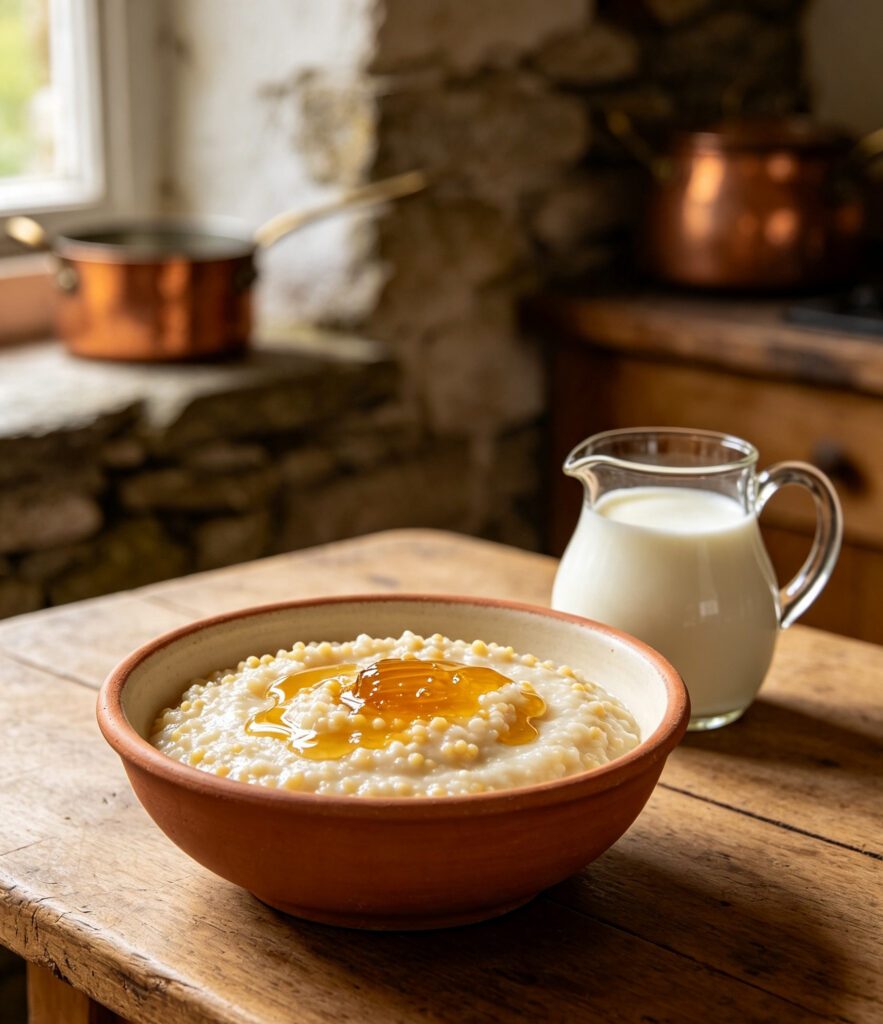
Millet Porridge with Honey and Sour Milk
The Quirky Foodster Team
Ingredients
- Millet, rinsed — 200 g (1 cup)
- Water — 750 ml (3 cups)
- Honey — 2 tbsp
- Sour milk (yogurt) — 200 ml (0.8 cup)
- Salt — 1 pinch
Method
- Place the rinsed millet and water in the pot and bring to a simmer.
- Cook for 25-30 minutes, stirring occasionally, until the millet is soft and the porridge has thickened.
- Season with a pinch of salt.
- Spoon into a serving bowl and top with the honey and sour milk.
- Serve warm.
Introduction: Millet simmered soft and served with a little honey and sour milk (yogurt), directly recorded as a welcoming meal offered to the traveller Ibn Battuta on his arrival at the edge of the Mali Empire in 1352.
Cultural Background: This dish is directly described in Ibn Battuta’s Rihla: on arriving at Walata, he was offered a bowl of millet with a little honey and yogurt as a welcoming meal, which he initially disparaged before being told by his hosts that this was considered a great banquet by local custom; it is one of the very few dishes in this entire collection recorded by an eyewitness observer actually eating it, rather than reconstructed from crop and trade evidence alone.
Tips: – Stir occasionally as the millet cooks to prevent it catching on the bottom of the pot. – Ibn Battuta’s own account describes only a little honey and yogurt atop the millet, a modest rather than lavish topping; keep the quantities restrained for an authentic feel.
Variations: – Naturally vegetarian; a vegan version can substitute a plant-based yogurt and a plant syrup for honey. – A thinner, more drinkable version can be made with extra water for a lighter breakfast.
Storage: Refrigerate covered for up to 3 days.
Reheating: Reheat gently in a pot over low heat with a splash of water, stirring, for 5 minutes; add the sour milk topping fresh after reheating.
Nutrition: Per serving (approx.): 230 kcal, 7 g protein, 42 g carbohydrate, 3 g fat, 4 g fibre.
FAQs:
Q: Is this dish really recorded by an eyewitness?
A: Yes, Ibn Battuta directly describes being offered a bowl of millet with a little honey and yogurt as a welcoming meal at Walata in 1352, one of only a handful of dishes in this entire collection recorded through firsthand eyewitness observation rather than reconstructed from crop evidence alone.
Q: Why did Ibn Battuta react poorly to this meal?
A: He initially considered it an unimpressive welcome given his experiences elsewhere in the Islamic world, remarking dismissively on it, until he was told by his hosts that this simple dish was in fact considered a great banquet by local custom, a detail that says as much about his own outsider expectations as about the food itself.
- Millet, rinsed — 200 g (1 cup)
- Water — 750 ml (3 cups)
- Honey — 2 tbsp
- Sour milk (yogurt) — 200 ml (0.8 cup)
- Salt — 1 pinch
Please log in to leave a comment.