
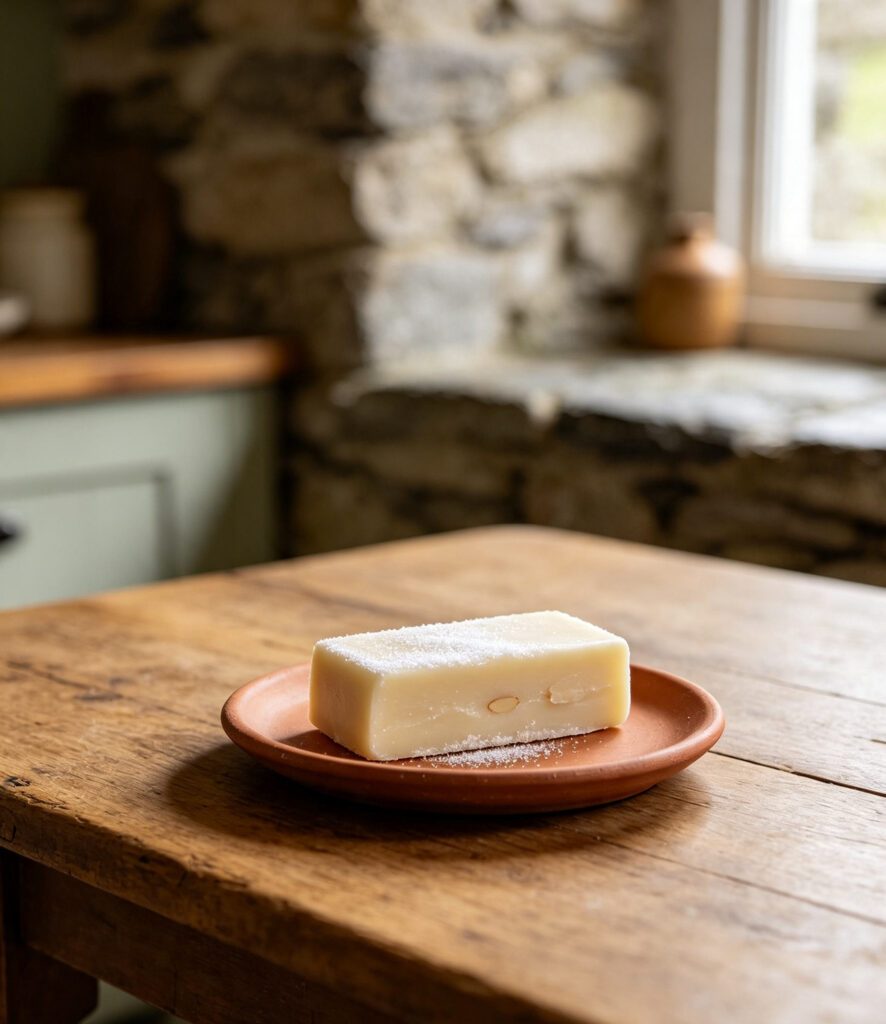
Marchpane (Tudor Marzipan)
The Quirky Foodster Team
Ingredients
- Ground almonds — 300 g (2.5 cups)
- Caster sugar — 200 g (1 cup)
- Large egg whites — 2
- Rosewater — 1 tbsp
- Icing sugar, for dusting and glazing — 2 tbsp
Method
- In a mixing bowl, combine the ground almonds and caster sugar.
- Add the egg whites and rosewater, and mix thoroughly until a firm, pliable paste forms.
- Turn the paste out onto a work surface dusted with icing sugar and knead briefly until smooth.
- Preheat the oven to 150°C (300°F). Shape or roll the marchpane into a round about 2 cm (3/4 in) thick, or press into a decorative mould if available, and place on the lined baking tray.
- Bake for 20-25 minutes, until the surface is just set and very lightly golden at the edges; take care not to over-brown.
- Allow to cool completely on the tray before dusting generously with icing sugar.
- Cut into wedges or small shapes to serve.
Introduction: A dense, sweet paste of ground almonds and sugar, often moulded into elaborate shapes and lightly browned, marchpane was one of the most prestigious sweets of the Tudor banqueting course.
Cultural Background: Marchpane was famously served at royal and noble feasts, including at the coronation banquets of the Tudor monarchs, and was sometimes crafted into elaborate sculpted forms such as castles or coats of arms as a display of wealth and skilled confectionery. It was a centrepiece of the final ‘banqueting course’, a separate sweet course served after the main meal.
Tips: (cid:127) Take care not to overbake, as marchpane should remain pale with only the faintest golden tinge, rather than deeply browned. (cid:127) For an authentic Tudor touch, use a hot salamander iron or a kitchen blowtorch briefly to lightly caramelise the icing sugar topping.
Variations: (cid:127) Press candied fruit or gilded almonds into the surface before baking for a more elaborate, banquet-worthy presentation. (cid:127) Colour a portion of the paste with a little beetroot juice or saffron for a decorative multi-coloured marchpane.
Storage: Store in an airtight container at room temperature for up to 2 weeks.
Reheating: No reheating required; marchpane is served at room temperature.
Nutrition: Per serving (approx.): 220 kcal, 6 g protein, 20 g carbohydrate, 14 g fat, 2 g fibre, 15 mg sodium.
FAQs:
Q: Is marchpane the same as modern marzipan?
A: It is very similar in ingredients, though Tudor marchpane was typically baked to set it, whereas modern marzipan is often used raw as a moulding paste. (cid:127) Q: Can I make this without baking it? A: Yes, a no-bake version can be shaped and left to firm up at room temperature for several hours, though this is a modern adaptation rather than the traditional baked method.
- Ground almonds — 300 g (2.5 cups)
- Caster sugar — 200 g (1 cup)
- Large egg whites — 2
- Rosewater — 1 tbsp
- Icing sugar, for dusting and glazing — 2 tbsp
Please log in to leave a comment.