
Appetizers
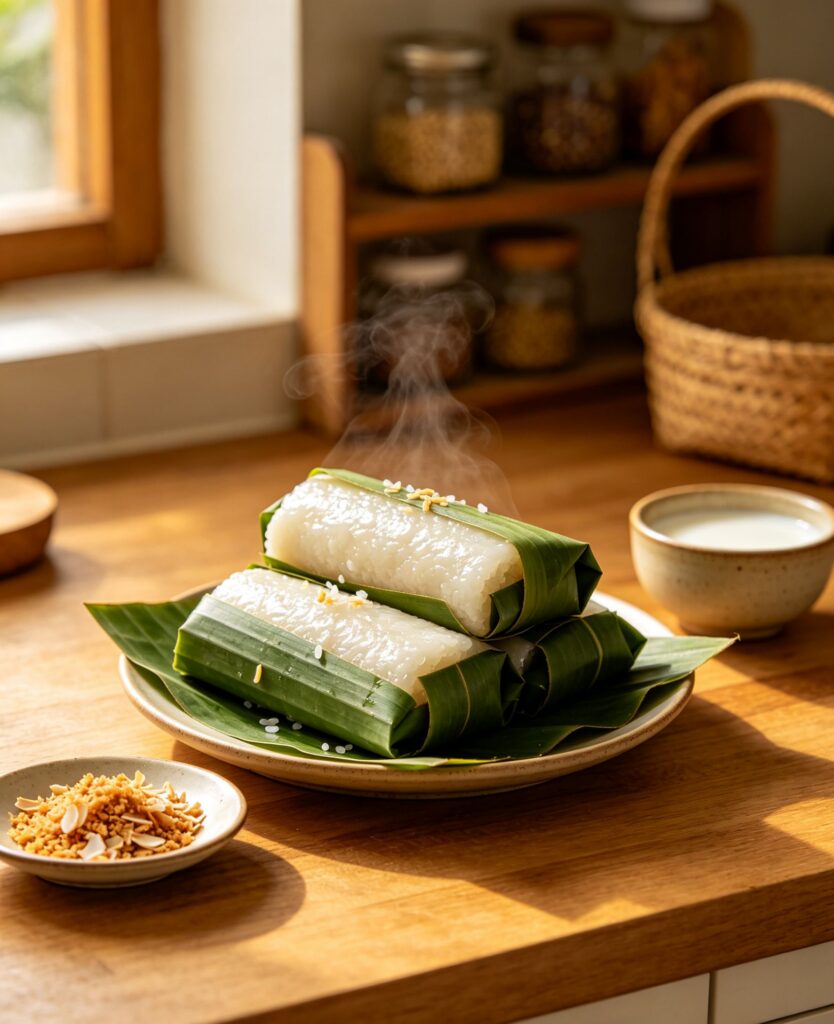
Kelupis (Steamed Glutinous Rice Rolls)
The Quirky Foodster Team
Ingredients
- 400 g Glutinous rice, soaked overnight and drained (2 cups)
- 250 ml Coconut milk (1 cup)
- 2 Pandan leaves, knotted
- 5 g Fine salt (1 tsp)
- 8 sheets Banana leaves or baking parchment, for wrapping (approx. 20 x 20 cm / 8 x 8 in each)
- 1 roll Kitchen string
Method
- Combine the soaked glutinous rice, coconut milk, pandan leaves and salt in a saucepan.
- Cook over low heat, stirring frequently, for 8–10 minutes until the liquid is mostly absorbed and the rice is glossy but not fully cooked. Remove the pandan leaves.
- Soften the banana leaves briefly over a flame or in hot water so they fold without cracking.
- Spoon about 3 tablespoons of the partially cooked rice mixture onto each leaf and roll into a tight log, folding in the ends.
- Tie each roll securely with kitchen string to hold its shape during steaming.
- Steam the rolls over boiling water for 45–50 minutes until the rice is fully cooked and firm.
- Cool completely before unwrapping — this allows the rolls to firm up and slice cleanly.
- Slice into rounds and serve with a curry or rendang for dipping.
Introduction: Kelupis are glutinous rice rolls made by the Bruneian Malay community, in which rice is first cooked in coconut milk and pandan before being wrapped in daun nyirik leaves and steamed until firm.
Cultural Background: Kelupis are glutinous rice rolls made by the Bruneian Malay community, in which rice is first cooked in coconut milk and pandan before being wrapped in daun nyirik leaves and steamed until firm. Once cooled and unwrapped, the rolls are dense and fragrant, traditionally served at weddings and family gatherings alongside a curry or spicy rendang for dipping.
Tips: Do not skip the pre-cooking step; raw soaked rice packed straight into leaves won't cook evenly during steaming. Tie the rolls firmly but not so tight that they split while the rice expands. Kelupis taste best served slightly warm or at room temperature, never hot from the steamer.
Variations: Some families add a thin strip of salted egg yolk or dried shrimp into the centre of the roll. Baking parchment can substitute for banana leaf, though the leaf lends a distinct aroma. Serve alongside beef rendang for the classic wedding-table pairing. Naturally vegan and gluten-free as written.
Storage: Store cooled, wrapped kelupis in the refrigerator for up to 3 days.
Reheating: Re-steam whole rolls for 10 minutes to soften, or slice and pan-fry briefly for a crisp edge.
Nutrition: Per roll: approx. 190 kcal, 3g protein, 32g carbohydrate, 6g fat.
FAQs:
Q: What are daun nyirik leaves?
A: They are a type of large tropical leaf traditionally used in Borneo for wrapping rice parcels; banana leaf is a widely available substitute.
Q: Can I freeze kelupis?
A: Yes — freeze the steamed, wrapped rolls for up to 1 month and thaw fully before re-steaming.
Q: Why pre-cook the rice before wrapping?
A: Pre-cooking ensures the dense, tightly wrapped rice cooks through evenly during the long steam.
Please log in to leave a comment.