
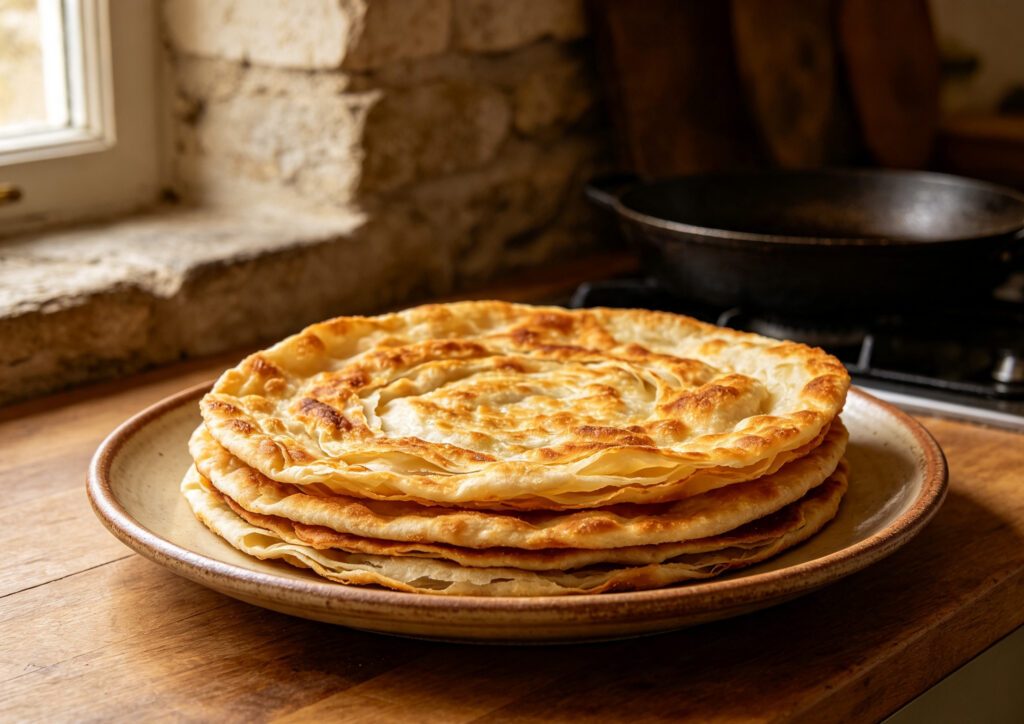
Katlama (Uzbek Fried Flatbread)
The Quirky Foodster Team
Ingredients
- Plain flour, plus extra for dusting — 500 g (4 cups)
- Salt — 1 tsp
- Warm water — 250 ml (1 cup)
- Butter, softened, or 100 ml (7 tbsp) vegetable oil — 100 g (7 tbsp)
- Medium onion, finely chopped (optional, for savory version) — 1
- Vegetable oil, for frying — 60 ml (4 tbsp)
Method
- In a large bowl, mix the flour and salt. Gradually add the warm water, mixing until a soft dough forms.
- Knead the dough on a lightly floured surface for 8–10 minutes until smooth and elastic.
- Cover with a damp kitchen towel and rest for 30 minutes at room temperature.
- Divide the dough into 4 equal balls. Roll each ball out thinly into a large circle, about 3 mm (1/8 inch) thick.
- Brush each circle generously with softened butter. If making the savory version, scatter chopped onion evenly over the surface.
- Roll each circle up tightly into a log, then coil the log into a spiral (like a snail shell) and tuck the end underneath.
- Rest the spirals for 10 minutes, then flatten each one gently with a rolling pin into a round disc about 20 cm (8 inches) wide, taking care not to press too hard so the layers stay intact.
- Heat 1 tbsp of oil in a large flat pan over medium heat. Fry each katlama for 3–4 minutes per side until golden brown and puffed, adding more oil as needed between batches.
- Transfer to a plate lined with paper towels to absorb excess oil. Serve warm.
Introduction: Katlama is a layered fried flatbread eaten across Uzbekistan for breakfast, often served warm with tea, honey, or jam.
Cultural Background: Katlama is a layered fried flatbread eaten across Uzbekistan for breakfast, often served warm with tea, honey, or jam. The word "katlama" comes from the Uzbek verb meaning "to fold," referring to the way the dough is rolled, layered with fat, and folded before frying to create flaky layers. It is a common home-cooked dish, especially in rural households where mornings begin with fresh bread and tea. Regional versions add caramelized onions or minced herbs between the layers for a savory take.
Tips: Resting the dough properly is key to achieving flaky layers, so don't skip the rest periods. Keep the heat at medium; too high and the outside burns before the layers cook through. Stack cooked katlama and cover with a towel to keep them soft and warm until serving.
Variations: Sweet version: brush layers with melted butter and a sprinkle of sugar instead of onion. Herb version: add finely chopped dill or cilantro to the butter layer. Vegan version: substitute butter and oil with a neutral plant-based oil throughout.
Storage: Store cooled katlama in an airtight container at room temperature for up to 2 days, or refrigerate for up to 5 days.
Reheating: Reheat in a dry skillet over low-medium heat for 1–2 minutes per side, or in an oven at 160°C (320°F) for 5 minutes, to restore crispness without drying it out.
FAQs:
Q: Can I make the dough ahead of time?
A: Yes, the dough can be made a day ahead and refrigerated; bring to room temperature before rolling.
Q: Why didn't my katlama get flaky layers?
A: This usually happens if the butter layer is too thin or the dough wasn't rested long enough before frying.
Q: Is katlama the same as a paratha?
A: They are similar in technique but katlama uses a distinct spiral-folding method and is traditionally eaten with tea rather than curry.
- Plain flour, plus extra for dusting — 500 g (4 cups)
- Salt — 1 tsp
- Warm water — 250 ml (1 cup)
- Butter, softened, or 100 ml (7 tbsp) vegetable oil — 100 g (7 tbsp)
- Medium onion, finely chopped (optional, for savory version) — 1
- Vegetable oil, for frying — 60 ml (4 tbsp)
Please log in to leave a comment.