
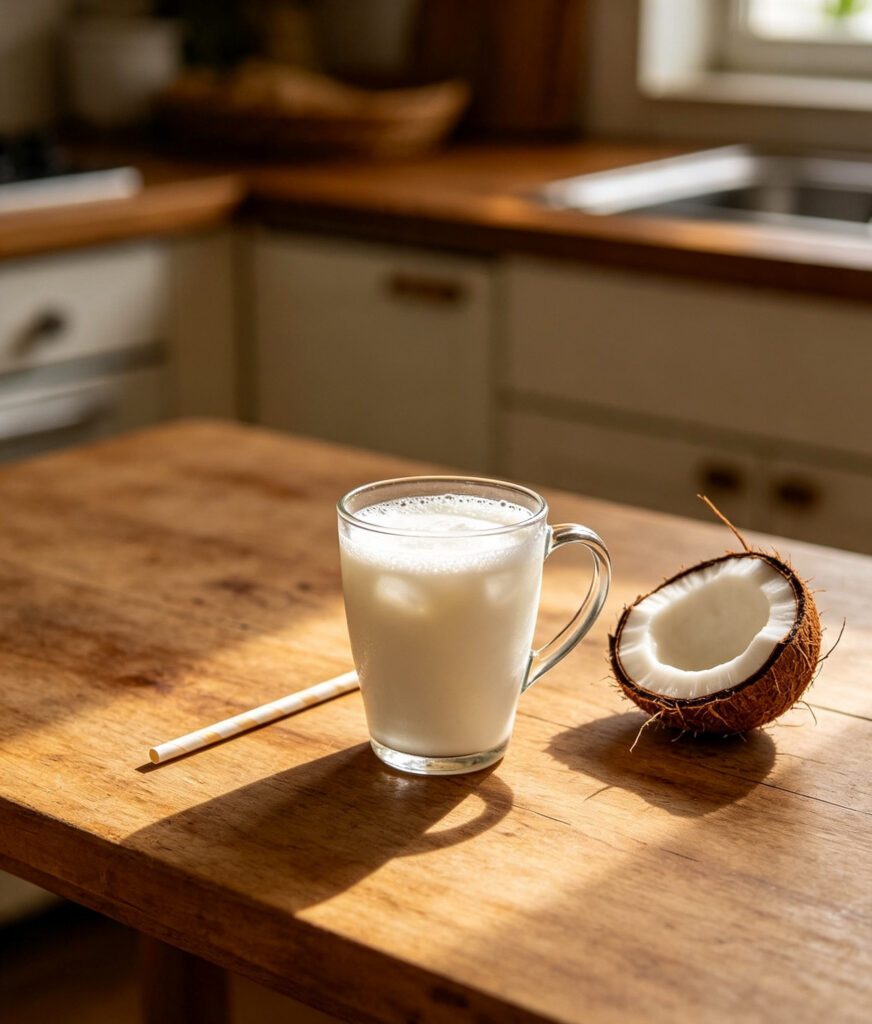
Kaleve (Fresh Coconut Toddy)
The Quirky Foodster Team
Ingredients
- Tree Access to a mature, healthy coconut palm with an unopened flower spathe — 1
- Clean coconut shell or bottle, for collecting — 1-2
- Fine string, for binding the spathe
Method
- Select a healthy palm with an unopened flower spathe and climb to reach it safely.
- Bind the spathe tightly with string a short distance below its tip.
- Cut off the very tip of the spathe to expose a small section of the unopened blossom.
- Shave a thin slice from the exposed blossom so the sap begins to seep from the cut.
- Suspend a clean coconut shell or bottle beneath the tip to catch the dripping sap.
- Collect the toddy twice daily, morning and evening, shaving a fresh thin layer from the blossom at each visit to keep the sap flowing.
- Drink the fresh kaleve as soon as possible after collection for the sweetest, mildest flavour.
Introduction: Kaleve, the sweet sap tapped from the unopened flower stem of the coconut palm, is one of the most
important drinks in Tuvalu, collected fresh every morning and evening by the household's toddy cutter.
Cultural Background: Kaleve, the sweet sap tapped from the unopened flower stem of the coconut palm, is one of the most
important drinks in Tuvalu, collected fresh every morning and evening by the household's toddy cutter.
Often compared to honey for its sweetness, it can be enjoyed straight from the tree or used to flavour
other dishes.
Tips: Collect the toddy promptly, ideally the same day, as it naturally begins to ferment and turn sour within hours in the tropical heat. A skilled, experienced toddy cutter is traditionally responsible for this task, as both the climbing and the precise cutting technique take practice.
Variations: Leave the collected toddy to ferment naturally for a day to make a mildly alcoholic version known locally as kao. Boil the fresh toddy down to make takai, a traditional hardened coconut candy. Naturally vegetarian as written. Naturally vegan as written; contains no animal products.
Storage: Best consumed fresh on the day of collection; if kept longer, it will begin to ferment naturally.
Reheating: Served fresh at room temperature or lightly chilled; not suitable for reheating.
FAQs:
Q: Is kaleve alcoholic?
A: Fresh kaleve is not alcoholic, but it begins to ferment naturally within a day, developing a mild alcohol content if left standing, at which point it is often called kao.
Q: Can kaleve be bought outside Tuvalu?
A: It is highly perishable and tied to fresh daily harvesting, so it is very rarely available commercially outside the Pacific region.
- Tree Access to a mature, healthy coconut palm with an unopened flower spathe — 1
- Clean coconut shell or bottle, for collecting — 1-2
- Fine string, for binding the spathe
Please log in to leave a comment.