
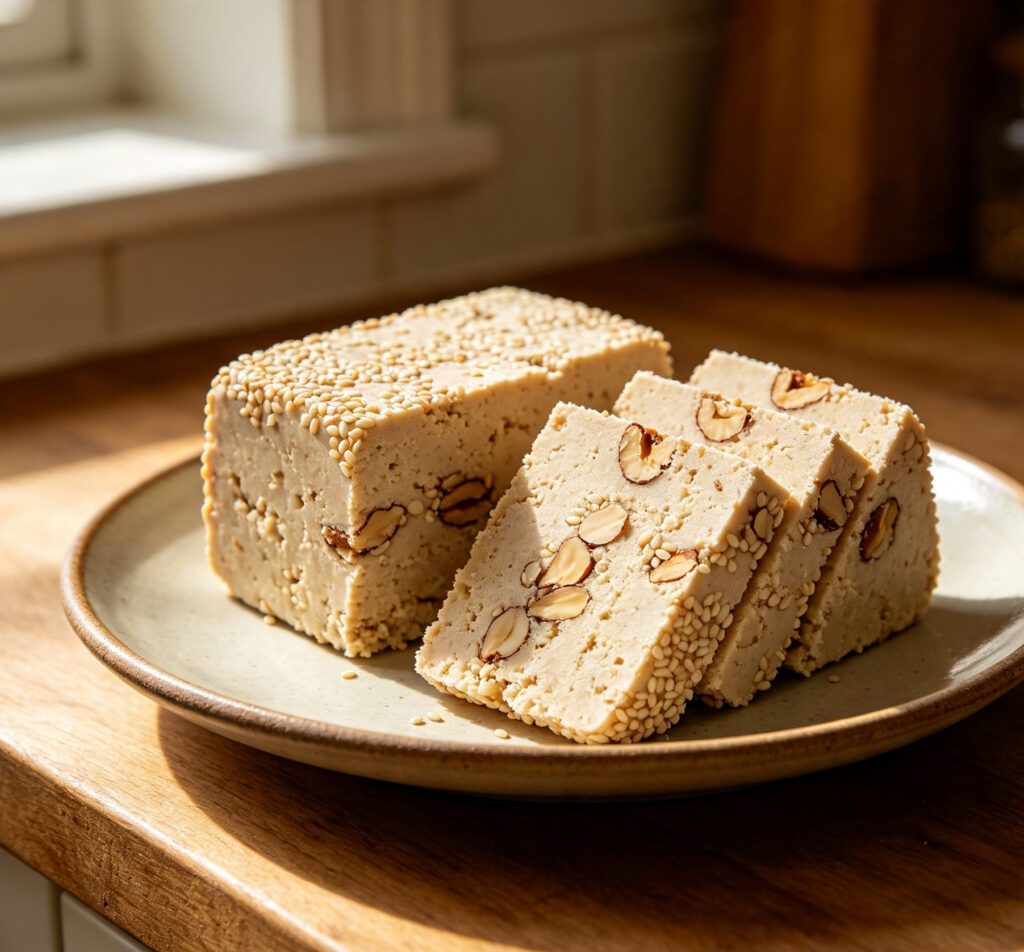
Halva (Uzbek Sesame And Nut Halva)
The Quirky Foodster Team
Ingredients
- Plain flour — 200 g (1.5 cups)
- Butter or ghee — 150 g (2/3 cup)
- Sugar — 200 g (1 cup)
- Water — 200 ml (3/4 cup plus 1 tbsp)
- Ground cardamom — 1/2 tsp
- Chopped walnuts or almonds — 80 g (2/3 cup)
- Sesame seeds, toasted — 2 tbsp
Method
- In a small saucepan, combine the sugar and water. Bring to a boil, stirring until the sugar dissolves, then simmer for 5 minutes to form a light syrup. Stir in the cardamom and set aside.
- In a large heavy-bottomed skillet, melt the butter over medium heat.
- Add the flour to the melted butter and cook, stirring constantly, for 12–15 minutes until the mixture turns a deep golden brown and smells toasted and nutty. Take care not to let it burn.
- Reduce heat to low and carefully pour in the sugar syrup, stirring quickly and constantly (the mixture will bubble and steam).
- Continue stirring for 3–4 minutes until the mixture thickens into a smooth, glossy paste.
- Stir in the chopped nuts, reserving a small handful for topping.
- Pour the mixture into a parchment-lined baking dish and press down firmly and evenly with the back of a spoon.
- Sprinkle the reserved nuts and toasted sesame seeds over the top, pressing gently to adhere.
- Let cool completely at room temperature for at least 2 hours before cutting into squares or diamonds.
Introduction: Uzbek halva is a dense, sweet confection made from toasted flour or sesame paste, sugar syrup, and nuts, prized for its rich, crumbly texture and long shelf life.
Cultural Background: Uzbek halva is a dense, sweet confection made from toasted flour or sesame paste, sugar syrup, and nuts, prized for its rich, crumbly texture and long shelf life. Halva holds cultural significance across Central Asia and the wider region, often served at celebrations, weddings, and religious holidays, and is traditionally made in large batches to share among family and guests.
Tips: Stir the flour constantly while toasting to prevent burning, as this step determines the halva's final flavor. Add the syrup carefully, as it will bubble vigorously when it hits the hot flour mixture. Allow the halva to cool fully before cutting for clean, neat pieces.
Variations: Substitute half the flour with toasted semolina for a different texture. Use pistachios or a mix of nuts for variety. Vegan version: substitute butter with a neutral plant-based oil or vegan butter.
Storage: Store in an airtight container at room temperature for up to 2 weeks, or refrigerate for up to 1 month.
Reheating: Halva is traditionally served at room temperature and does not require reheating.
FAQs:
Q: Why is my halva grainy instead of smooth?
A: This can happen if the sugar syrup crystallizes; make sure to dissolve the sugar fully before boiling and avoid stirring the syrup once it's simmering.
Q: Can I make halva without nuts?
A: Yes, nuts can be omitted or substituted with seeds for a nut-free version, though they add valuable texture and flavor.
Q: How long does halva keep?
A: Properly stored in an airtight container, halva keeps well for up to 2 weeks at room temperature.
- Plain flour — 200 g (1.5 cups)
- Butter or ghee — 150 g (2/3 cup)
- Sugar — 200 g (1 cup)
- Water — 200 ml (3/4 cup plus 1 tbsp)
- Ground cardamom — 1/2 tsp
- Chopped walnuts or almonds — 80 g (2/3 cup)
- Sesame seeds, toasted — 2 tbsp
Please log in to leave a comment.