
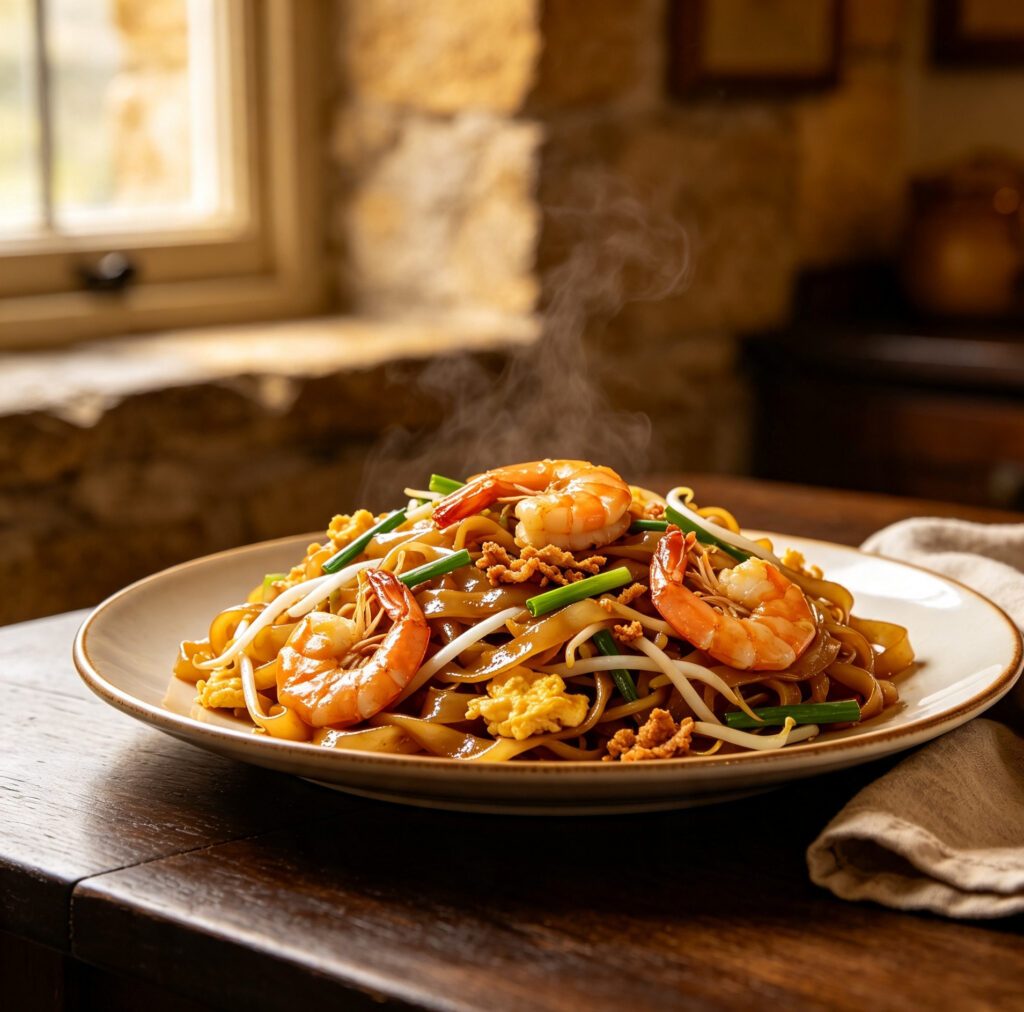
Char Kway Teow
The Quirky Foodster Team
Ingredients
- Fresh flat rice noodles (kway teow) — 500 g (1.1 lb)
- Prawns, peeled — 150 g (5 oz)
- Chinese sausage (lap cheong), sliced — 100 g (3.5 oz)
- Eggs — 2
- Fish cake, sliced — 100 g (3.5 oz)
- Bean sprouts — 150 g (5 oz)
- Garlic chives, cut into lengths — 2 stalks
- Garlic cloves, minced — 3
- Dark soy sauce — 3 tbsp
- Light soy sauce — 2 tbsp
- Chilli paste (optional, to taste) — 1 tbsp
- Vegetable oil or lard — 3 tbsp
- Cockles, shelled (optional) — 100 g (3.5 oz)
Method
- Heat the oil or lard in a wok over the highest heat until lightly smoking.
- Add the garlic and Chinese sausage, and stir-fry for 1-2 minutes until fragrant.
- Add the prawns and fish cake, and stir-fry for 2 minutes until the prawns turn pink.
- Push the ingredients to one side, crack in the eggs and scramble briefly, then add the noodles.
- Add the dark soy sauce, light soy sauce and chilli paste if using, tossing constantly over high heat for 3-4 minutes.
- Add the bean sprouts, garlic chives and cockles if using, and toss for a final 1-2 minutes until everything is well combined and lightly charred. Serve immediately.
Introduction: Char kway teow, meaning 'stir-fried flat noodles', is one of Singapore's most iconic hawker dishes, flat rice noodles stir-fried over intense heat with prawns, Chinese sausage, egg, bean sprouts and cockles in a smoky, dark soy-based sauce.
Cultural Background: Char kway teow, meaning 'stir-fried flat noodles', is one of Singapore's most iconic hawker dishes, flat rice noodles stir-fried over intense heat with prawns, Chinese sausage, egg, bean sprouts and cockles in a smoky, dark soy-based sauce. Originally a cheap, calorie-rich meal for labourers, it is now celebrated for its distinctive 'wok hei', the elusive charred aroma from high-heat wok cooking.
Tips: Cook over the highest heat your stove allows, and keep the ingredients moving constantly to develop the signature smoky 'wok hei' flavour. Use fresh, slightly warm noodles if possible; cold noodles from the fridge can clump and break more easily.
Variations: Omit the cockles for a simpler, more widely accessible version. Add a spoonful of pork lard cracklings for extra richness, a traditional hawker touch. Omit the prawns, sausage, fish cake and cockles, using extra vegetables and a vegetarian dark soy sauce, for a vegetarian version.
Storage: Best eaten immediately; leftovers can be refrigerated for up to 1 day but texture changes considerably.
Reheating: Reheat in a very hot wok or pan briefly, tossing constantly, to avoid the noodles turning mushy.
Nutrition: Approx. 560 kcal, 24g protein, 62g carbs, 24g fat, 2g fibre per serving.
FAQs:
Q: What is 'wok hei'?
A: Wok hei, meaning 'breath of the wok', refers to the distinctive smoky aroma and flavour achieved through very high heat stir-frying, prized in dishes like char kway teow.
Q: Can I use dried noodles instead of fresh?
A: Fresh flat rice noodles are traditional and give the best texture; dried rice noodles can be used but should be soaked and cooked until just tender first.
- Fresh flat rice noodles (kway teow) — 500 g (1.1 lb)
- Prawns, peeled — 150 g (5 oz)
- Chinese sausage (lap cheong), sliced — 100 g (3.5 oz)
- Eggs — 2
- Fish cake, sliced — 100 g (3.5 oz)
- Bean sprouts — 150 g (5 oz)
- Garlic chives, cut into lengths — 2 stalks
- Garlic cloves, minced — 3
- Dark soy sauce — 3 tbsp
- Light soy sauce — 2 tbsp
- Chilli paste (optional, to taste) — 1 tbsp
- Vegetable oil or lard — 3 tbsp
- Cockles, shelled (optional) — 100 g (3.5 oz)
Please log in to leave a comment.