
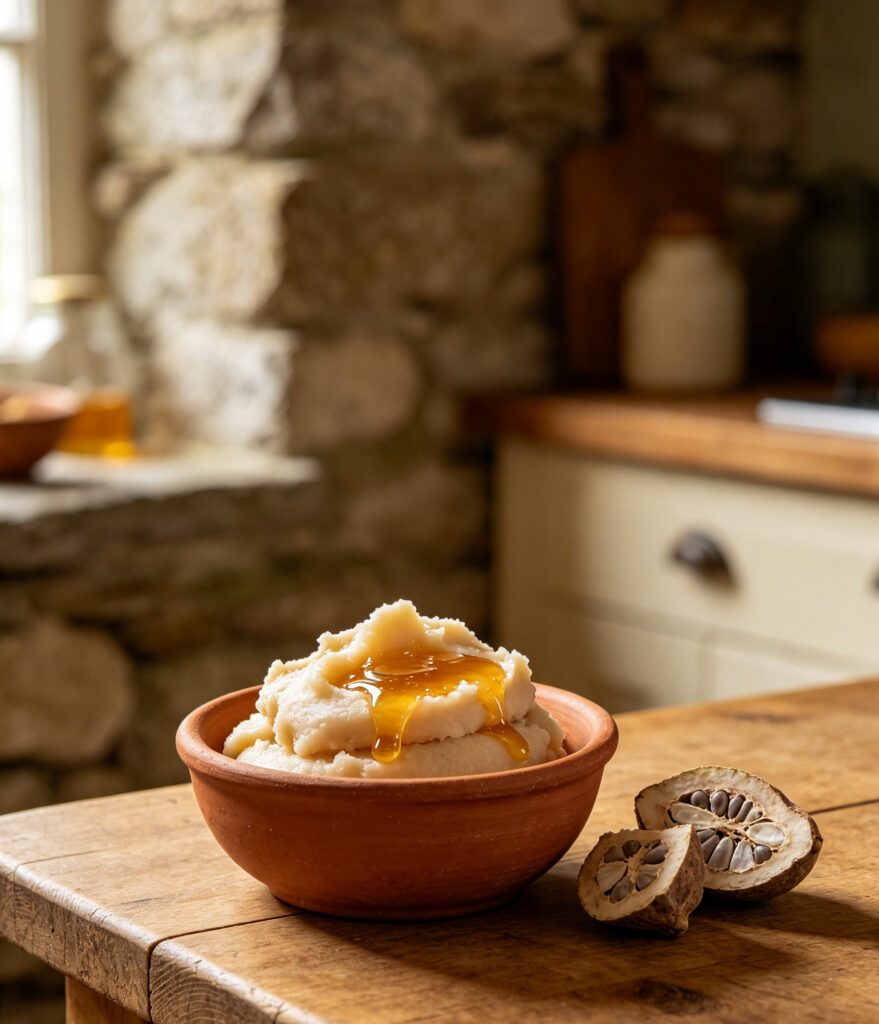
Baobab Fruit with Honey
The Quirky Foodster Team
Ingredients
- Baobab fruit pulp powder — 100 g (0.5 cup)
- Honey — 3 tbsp
- Water — 2 tbsp
Method
- Combine the baobab fruit pulp powder and water in the bowl, stirring to a thick paste.
- Stir in the honey until evenly combined.
- Serve at room temperature.
Introduction: The tart, powdery pulp of baobab fruit mixed with honey, a naturally sweet dish from a tree deeply woven into the Sahelian landscape of the Mali Empire.
Cultural Background: As established in the Soups section, the baobab tree is native to the African savanna belt that includes the core Mali Empire territory, and its fruit, sometimes called ‘monkey bread’ in later usage, has a distinctively tart, powdery pulp that has been used as a food source across the Sahel for a very long history; combining it with honey, a broadly available regional sweetener, gives a simple dessert from two well-grounded native foods.
Tips: – Baobab fruit pulp powder is naturally tart; adjust the honey to taste depending on how sharp the specific batch is. – The mixture thickens slightly as it sits; loosen with a touch more water if needed.
Variations: – Naturally vegetarian; a vegan version can substitute a plant-based syrup for honey. – A little of the mixture can be added to water for a refreshing drink, similar to the Bouye drink in the Drinks section.
Storage: Refrigerate covered for up to 3 days.
Reheating: Not applicable; served cold or at room temperature.
Nutrition: Per serving (approx.): 110 kcal, 1 g protein, 28 g carbohydrate, 0.3 g fat, 3 g fibre.
FAQs:
Q: What does baobab fruit taste like?
A: A distinctively tart, slightly citrusy flavour with a dry, powdery texture once the pulp has dried naturally inside the fruit’s hard shell, quite different from most other fruits.
Q: Is baobab fruit still eaten in West Africa today?
A: Yes, it remains a valued and widely used food across the Sahel today, and has also gained wider international recognition in recent years as a nutrient-dense natural product.
- Baobab fruit pulp powder — 100 g (0.5 cup)
- Honey — 3 tbsp
- Water — 2 tbsp
Please log in to leave a comment.