
Global
Chopsticks Family (Cross-Cultural Overview)
China, with independent regional evolution across Japan, Korea, and Vietnam
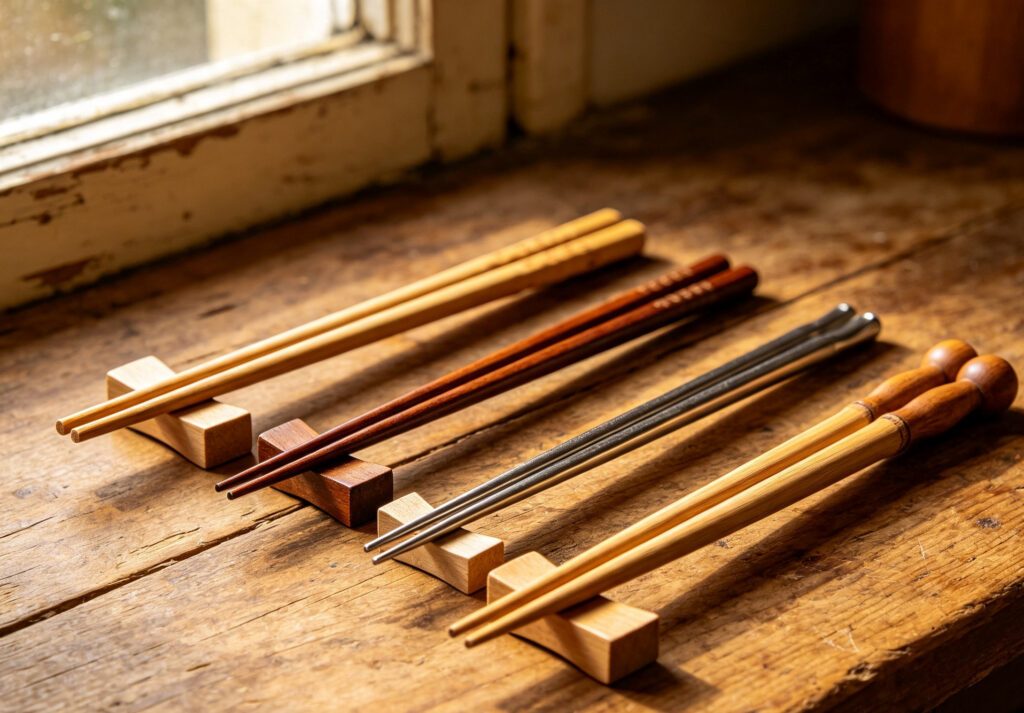
Chopsticks spread from China across East and Southeast Asia, diverging into recognizably distinct regional forms — China's longer, blunt-tipped kuaizi, Japan's shorter, pointed hashi, Korea's flat metal sujeo, and Vietnam's đũa — each shaped by differences in typical serving style and dining custom.
Material & Construction
Material and cross-section vary distinctly by region: wood and bamboo dominate in China, Japan, and Vietnam, while Korea's use of flat metal chopsticks is a notable regional departure.
Traditional Uses
Everyday eating, with regional variation reflecting differences in typical dish format — communal reaching (favoring longer chopsticks) versus individual bone-heavy fish dishes (favoring the fine point of Japanese hashi).
Modern Availability / Equivalents
Each regional style remains the standard within its own dining tradition; none has been displaced by another despite their shared origin.
Care & Maintenance
Care varies with the material.
Chopsticks diverged regionally from a shared origin — Chinese kuaizi, Japanese hashi, Korean sujeo and Vietnamese đũa.
Please log in to leave a comment.