
Chadian Bouillie de Mil
The Quirky Foodster Team
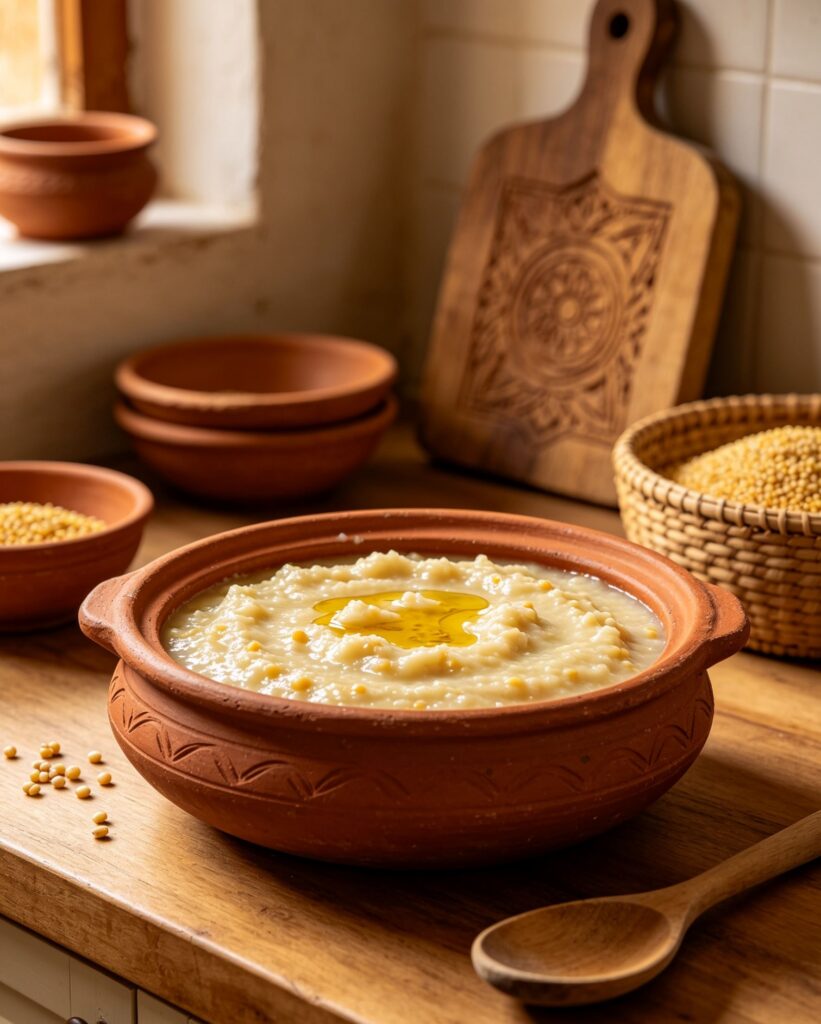
Ingredients
- Millet flour — 200 g (1 cup)
- Water, divided — 1 L (4 cups)
- Milk (dairy or plant-based) — 60 ml (1/4 cup)
- Sugar, or to taste — 2 tbsp
- Salt — 1 pinch
- Ground ginger (optional) — 1/4 tsp
Method
- In a bowl, mix the millet flour with 250ml (1 cup) of the cold water to form a smooth, lump-free paste.
- Bring the remaining 750ml (3 cups) of water to a boil in a saucepan over medium-high heat.
- Whisking constantly, pour the millet paste into the boiling water in a thin stream.
- Reduce heat to low and simmer for 8-10 minutes, stirring frequently, until thickened and smooth.
- Stir in the milk, sugar, salt and ginger (if using), and simmer for 2 more minutes.
- Pour into bowls and serve warm.
Introduction: A smooth, warming millet porridge eaten across Chad at the start of the day, especially in rural Sahelian households.
Cultural Background: A smooth, warming millet porridge eaten across Chad at the start of the day, especially in rural Sahelian households. Millet has been the backbone grain of Chadian agriculture for centuries, and this porridge is often the first food given to children and the last food offered to elders, valued for being gentle, filling and easy to digest.
Tips: Sift the millet flour before mixing with water to avoid lumps. Adjust thickness by adding a splash more water for a thinner porridge, or simmering longer for a thicker one.
Variations: Sorghum flour can be substituted for millet for a slightly earthier flavour. For a savoury version popular with adults, omit the sugar and add a pinch of salt with a spoon of peanut butter stirred through. Naturally vegetarian; use plant-based milk for a fully vegan version.
Storage: Store leftovers in an airtight container in the refrigerator for up to 2 days.
Reheating: Reheat gently on the stovetop over low heat, stirring in a splash of milk or water to loosen the texture.
Nutrition: Approx. 190 kcal, 4g protein, 38g carbohydrate, 2g fat per serving (based on 4 servings).
FAQs
Q: Can I make this dairy-free?
A: Yes, use oat, soy or coconut milk in place of dairy milk with no change to method.
Q: Why is my porridge lumpy?
A: This happens if the flour is added directly to boiling water. Always mix it with cold water first to form a paste.
- Millet flour — 200 g (1 cup)
- Water, divided — 1 L (4 cups)
- Milk (dairy or plant-based) — 60 ml (1/4 cup)
- Sugar, or to taste — 2 tbsp
- Salt — 1 pinch
- Ground ginger (optional) — 1/4 tsp
Please log in to leave a comment.