
Armudu Black Tea
The Quirky Foodster Team
Ingredients
- Loose black tea leaves — 2 tbsp
- Freshly boiled water — 600 ml (2.5 cups)
- Sugar cubes, to serve
- Fruit preserves (such as fig or quince jam), to serve
Method
- Warm the small teapot with a little boiling water, then discard.
- Add the loose tea leaves to the teapot and pour over a small amount of boiling water, just enough to cover the leaves.
- Steep for 3-5 minutes to create a strong concentrate.
- Top up the teapot with more boiling water, or dilute the concentrate directly in each armudu glass to taste.
- Serve immediately with sugar cubes and a small dish of fruit preserves alongside.
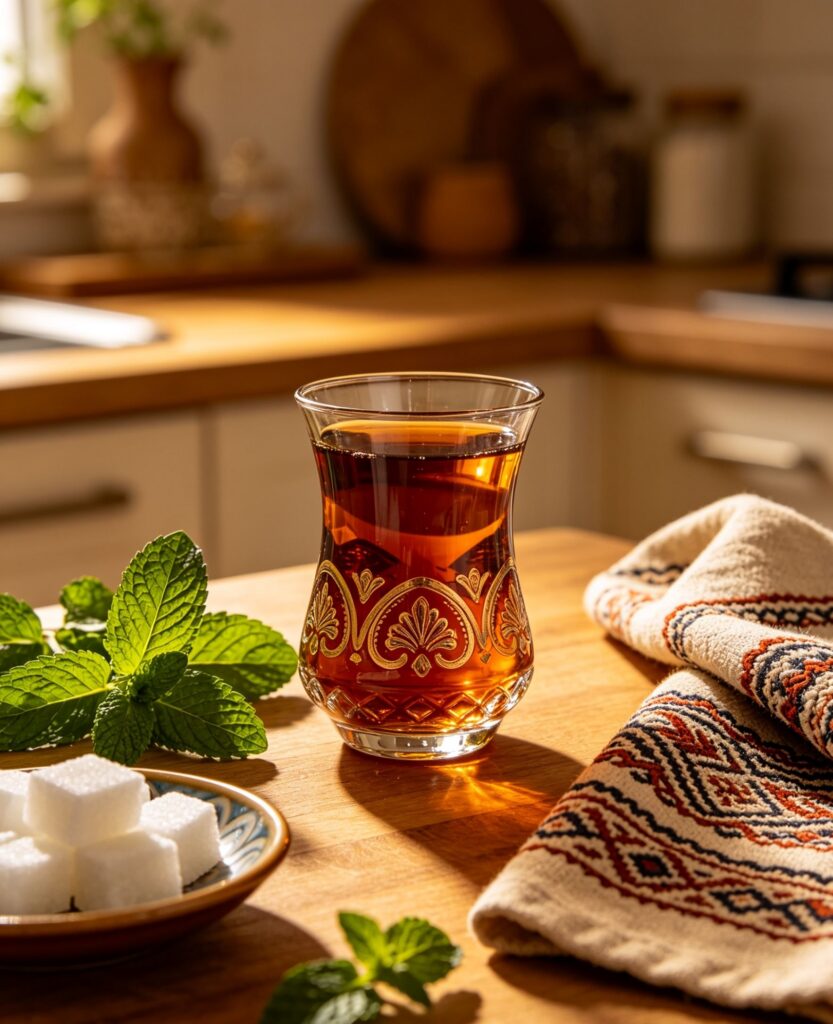
Introduction: Tea is central to Azerbaijani hospitality, brewed strong in a samovar and served in a distinctive pear-shaped glass called an armudu.
Cultural Background: Tea is central to Azerbaijani hospitality, brewed strong in a samovar and served in a distinctive pear-shaped glass called an armudu. Sugar is traditionally enjoyed not stirred in, but as a cube bitten and sipped through, in a custom known as dishleme.
Tips: Serving tea in a proper armudu glass is more than decorative — its narrow waist keeps the top hot while the base stays cool enough to hold. Offer preserves alongside, not stirred into the tea; guests traditionally take a small spoonful between sips.
Variations: A version with a few threads of saffron added while steeping is served on special occasions. Some households add a slice of lemon to the glass.
Storage: Best brewed fresh; store dry tea leaves in an airtight container away from light.
Reheating: Reheat gently on the stovetop if the tea has cooled, though it is best drunk freshly brewed.
Nutrition: Approx. 2 kcal, 0 g protein, 0 g fat, 0 g carbohydrate per serving (without sugar).
FAQs:
Q: Why is the tea glass pear-shaped?
A: The armudu shape keeps the tea at the ideal temperature for longer and reflects a long-standing Azerbaijani tradition.
Q: What is dishleme?
A: It is the custom of biting a sugar cube and sipping tea through it, rather than stirring sugar directly into the glass.
- Loose black tea leaves — 2 tbsp
- Freshly boiled water — 600 ml (2.5 cups)
- Sugar cubes, to serve
- Fruit preserves (such as fig or quince jam), to serve
Please log in to leave a comment.