
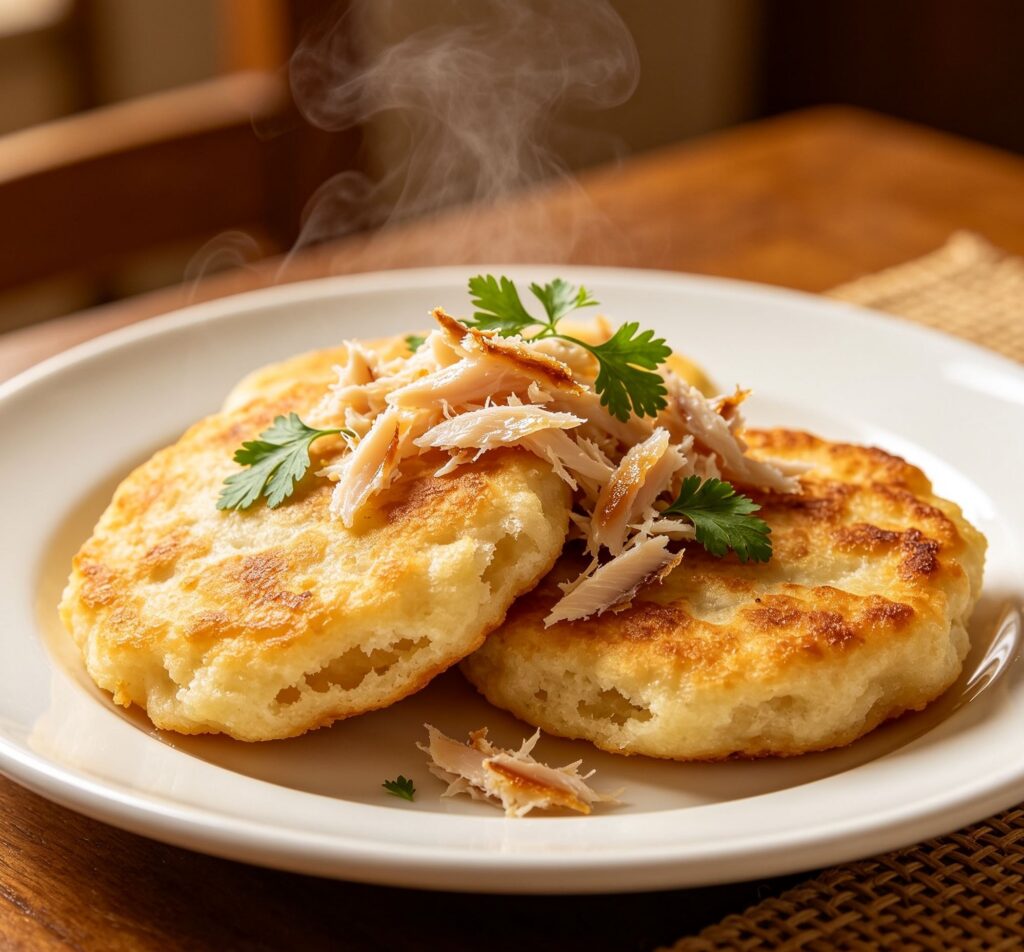
Johnny Cakes with Saltfish (Johnny Cake)
The Quirky Foodster Team
Ingredients
- Johnny Cakes:
- All-purpose flour — 500 g (4 cups)
- Baking powder — 2 tsp (2 tsp)
- Salt — 1 tsp (1 tsp)
- Sugar — 2 tbsp (2 tbsp)
- Butter, softened — 2 tbsp (2 tbsp)
- Water, approximately — 250 ml (1 cup)
- Vegetable oil, for deep frying
- Saltfish topping:
- Salted cod — 300 g (10 oz)
- Vegetable oil — 1 tbsp (1 tbsp)
- Small onion, sliced — 1
- Garlic, minced — 1 clove
- Medium tomato, chopped — 1
- Black pepper, — to taste
Method
- Soak the saltfish in cold water for at least 8 hours, changing the water twice, then simmer for 15 minutes, drain, and flake, removing skin and bones.
- In a large bowl, whisk together flour, baking powder, salt and sugar. Rub in the butter until the mixture resembles coarse crumbs.
- Gradually add water, mixing until a soft, slightly sticky dough forms. Knead briefly for 2 minutes on a floured surface.
- Rest the dough for 15 minutes, then divide into small, golf ball-sized pieces and flatten slightly into discs.
- Heat oil in a deep pot to 170°C (340°F). Fry the discs in batches for 3–4 minutes per side until deep golden and cooked through. Drain on paper towels.
- For the saltfish, heat oil in a skillet, sauté onion and garlic, add tomato and cook 5 minutes, then stir in the flaked saltfish and black pepper; cook a further 5 minutes.
- Split warm johnny cakes and serve stuffed or topped with the saltfish mixture.
Introduction: Johnny cakes are small, golden fried dough balls found throughout the Caribbean, though the Antiguan version is distinctly smaller — often no larger than a golf ball — and eaten in generous numbers.
Cultural Background: Johnny cakes are small, golden fried dough balls found throughout the Caribbean, though the Antiguan version is distinctly smaller — often no larger than a golf ball — and eaten in generous numbers. Believed to descend from British “journey cakes ,” portable bread taken on long trips, the dish was adapted using local flour, cornmeal and coconut, and became a breakfast and snack staple. In Antigua and Barbuda , johnny cakes are almost always served with a savoury partner, most traditionally saltfish, making a satisfying handheld breakfast that pairs a crisp, fluffy bread with a salty, well-seasoned fish stew.
Tips: Keep the oil temperature steady; too hot and the cakes brown before cooking through, too cool and they absorb excess oil. Test the oil with a small piece of dough first — it should sizzle and rise steadily.
Variations: Some bakers add a spoonful of grated coconut to the dough for a subtly sweet, nutty flavour. Johnny cakes can also be served plain with butter and cheese as a simpler breakfast.
Vegetarian/Vegan: Johnny cakes alone are vegetarian; for a vegan option, replace butter in the dough with coconut oil and serve with a vegetable filling instead of saltfish.
Storage: Store cooled johnny cakes in an airtight container at room temperature for up to 2 days, or refrigerate for up to 5 days.
Reheating: Warm in a 160°C (320°F) oven for 8–10 minutes to restore crispness; avoid microwaving, which softens the crust.
Nutrition: Calories: 420 kcal | Protein: 18 g | Carbohydrates: 48 g | Fat: 18 g | Fibre: 2 g | Sodium: 760 mg
FAQs:
Q: Why are Antiguan johnny cakes smaller than in other islands?
A: Local tradition favours bite-sized cakes so more can be shared at a single meal ; larger versions are common elsewhere in the Caribbean.
Q: Can johnny cake dough be made ahead?
A: Yes, the dough can rest, covered, in the refrigerator for up to 24 hours before frying.
- Johnny Cakes:
- All-purpose flour — 500 g (4 cups)
- Baking powder — 2 tsp (2 tsp)
- Salt — 1 tsp (1 tsp)
- Sugar — 2 tbsp (2 tbsp)
- Butter, softened — 2 tbsp (2 tbsp)
- Water, approximately — 250 ml (1 cup)
- Vegetable oil, for deep frying
- Saltfish topping:
- Salted cod — 300 g (10 oz)
- Vegetable oil — 1 tbsp (1 tbsp)
- Small onion, sliced — 1
- Garlic, minced — 1 clove
- Medium tomato, chopped — 1
- Black pepper, — to taste
Please log in to leave a comment.