
Kola Nut and Fresh Fruit (Hospitality Offering)
The Quirky Foodster Team
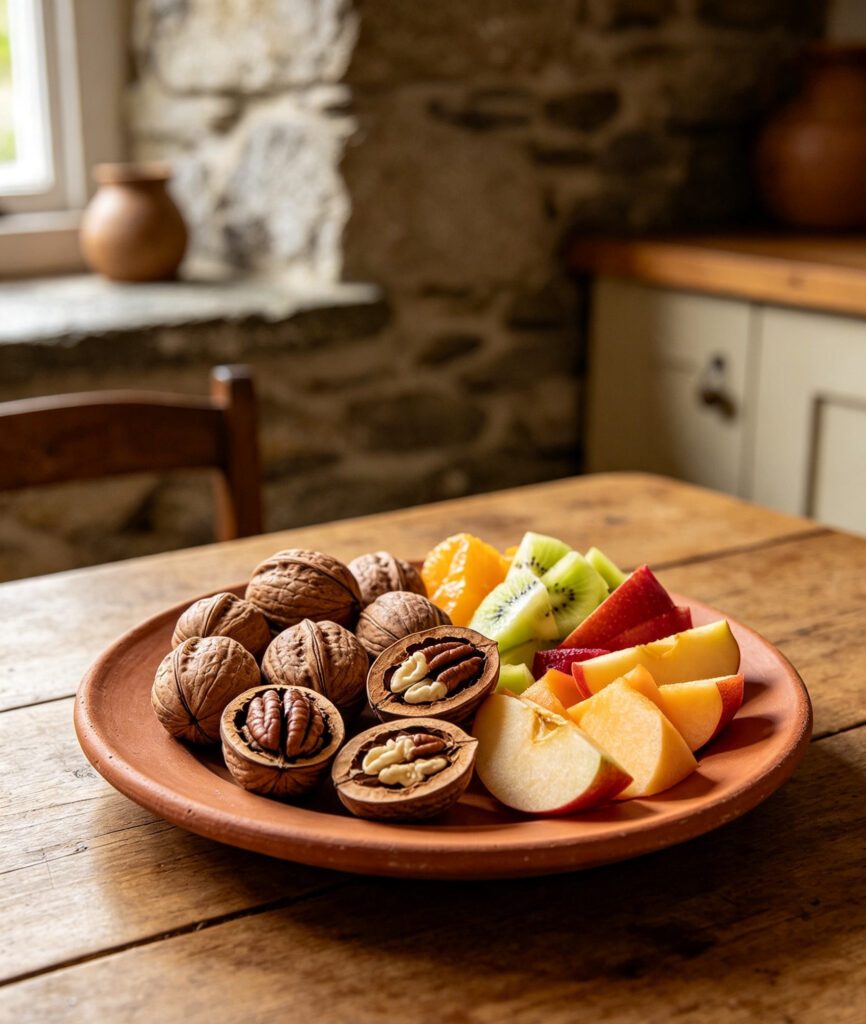
Ingredients
- Whole kola nuts — 6-8
- A selection of fresh seasonal fruit (melon, dates if available via trade, or similar)
Method
- Arrange the whole kola nuts on a serving plate or in a small basket.
- Arrange the fresh fruit alongside.
- Present to guests as a gesture of welcome, in keeping with long-documented regional hospitality custom.
Introduction: Kola nuts served alongside fresh fruit as a gesture of welcome, reflecting the kola nut’s extensively documented role as both a valuable Mali Empire trade good and a customary offering of hospitality.
Cultural Background: Kola nuts are directly documented as passing through the great trading centre of Timbuktu as one of the significant goods of the Mali Empire’s commercial network, valued for their mildly stimulant properties; the practice of offering kola nuts as a gesture of welcome and hospitality is a very old and still-continuing West African custom, making this presentation a plausible and well-grounded reconstruction even though no single period source names this exact combined dish.
Tips: – Kola nuts are traditionally offered whole and broken by the recipient themselves as part of the hospitality gesture, rather than pre-broken by the host. – Pair with whatever fresh fruit is genuinely in season locally for the most appropriate presentation.
Variations: – Naturally vegan as written. – Dates, arriving via the same trans-Saharan trade routes that carried salt and gold, make a historically apt fruit pairing where available.
Storage: Whole kola nuts keep for a few weeks at room temperature; fruit should be kept fresh and used promptly.
Reheating: Not applicable; served fresh at room temperature.
Nutrition: Per serving (approx.): 60 kcal, 1 g protein, 12 g carbohydrate, 0.5 g fat. Contains caffeine and other mild stimulant compounds naturally present in kola nut.
FAQs:
Q: Were kola nuts really significant to the Mali Empire’s economy?
A: Yes, kola nuts are directly documented as one of the goods passing through Timbuktu, the empire’s great trading centre, alongside ivory, textiles, and cereals, reflecting their genuine commercial and cultural importance.
Q: Is offering kola nuts as hospitality a real historical custom?
A: Yes, this is a very old and still-continuing West African custom of welcome and respect; while no single Mali Empire-era source names this exact combined presentation, the underlying practice of kola nut hospitality is extremely well documented across the region’s history.
- Whole kola nuts — 6-8
- A selection of fresh seasonal fruit (melon, dates if available via trade, or similar)
Please log in to leave a comment.