
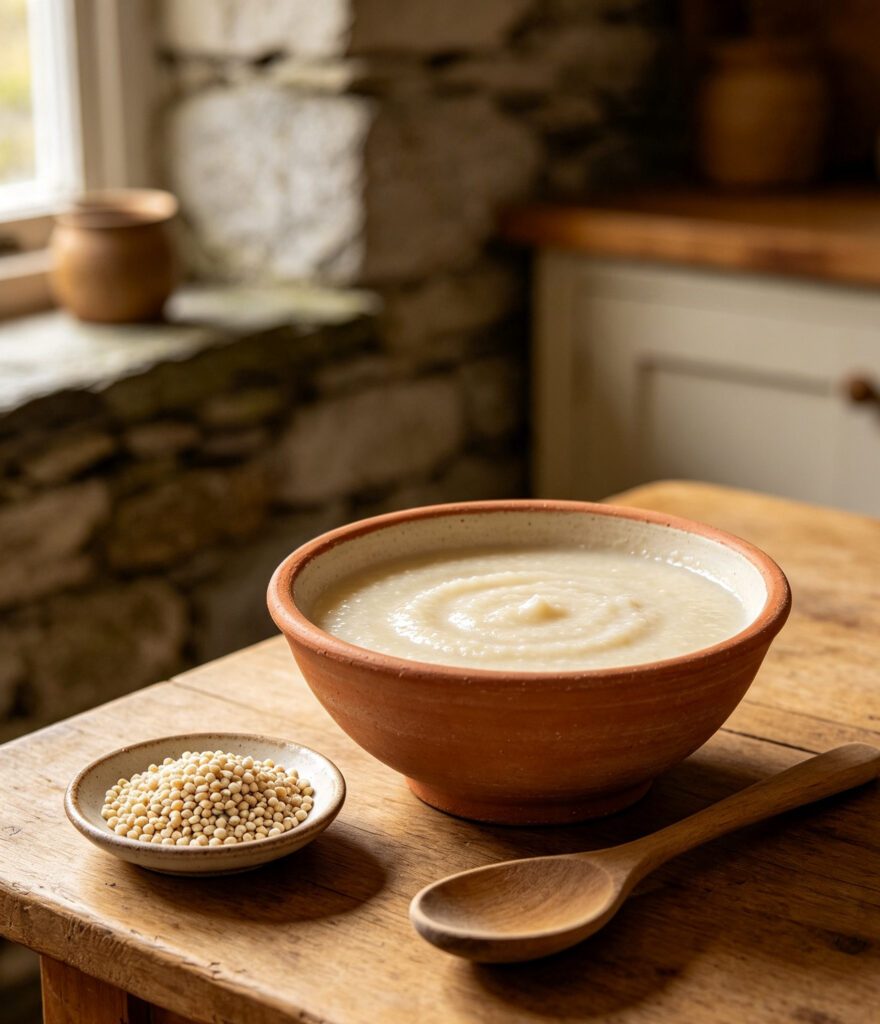
Fonio Gruel (Funi)
The Quirky Foodster Team
Ingredients
- Fonio grain — 200 g (1 cup)
- Water — 600 ml (2.5 cups)
- Salt — 1 pinch
Method
- Rinse the fonio briefly in cold water and drain.
- Bring the water to a simmer in the pot and add the fonio.
- Cook for 8-10 minutes, stirring frequently, until the grain has softened and the mixture has thickened to a soft gruel; fonio cooks considerably faster than millet or sorghum.
- Season with salt and serve warm.
Introduction: A soft gruel made from fonio, a tiny native West African grain directly named by Ibn Battuta, who describes it as resembling mustard seed and used to make couscous and gruel.
Cultural Background: Ibn Battuta directly names ‘funi’ among the foods offered to him by local women along the Niger River, describing it as a grain resembling mustard seed, from which couscous and gruel were made; this corresponds to fonio (Digitaria exilis), a genuinely native West African cereal still cultivated today and among the oldest domesticated grains in the region, making this one of the more directly attested dishes in this collection.
Tips: – Fonio cooks very quickly compared to other West African grains; watch closely to avoid it sticking once thickened. – A little sour milk or honey can be added on top, following the same general pattern Ibn Battuta records for millet.
Variations: – Naturally vegan as written. – The same cooked fonio can be steamed instead of simmered directly, producing a couscous-like result, matching Ibn Battuta’s own description of its dual use.
Storage: Refrigerate covered for up to 2 days.
Reheating: Reheat gently in a pot over low heat with a splash of water, stirring, for 3-4 minutes.
Nutrition: Per serving (approx.): 170 kcal, 4 g protein, 36 g carbohydrate, 1 g fat, 2 g fibre.
FAQs:
Q: Is fonio directly named in a historical source?
A: Yes, Ibn Battuta directly names ‘funi’ among the foods offered to him along the Niger River, describing it as a grain resembling mustard seed used to make both couscous and gruel, making this one of the more directly attested grains in this entire collection.
Q: Is fonio still eaten in West Africa today?
A: Yes, fonio remains cultivated and eaten across West Africa today, representing a genuinely unbroken culinary tradition from the period described by Ibn Battuta into the present.
- Fonio grain — 200 g (1 cup)
- Water — 600 ml (2.5 cups)
- Salt — 1 pinch
Please log in to leave a comment.