
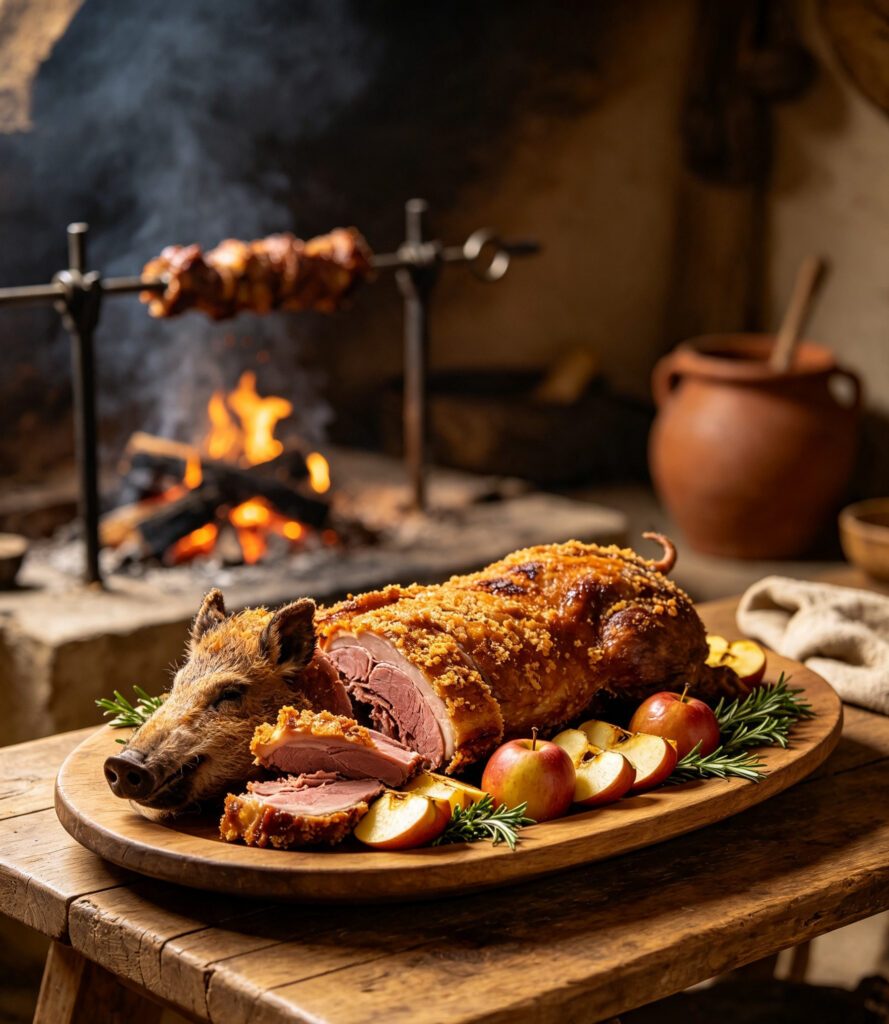
Spit-Roasted Boar
The Quirky Foodster Team
Ingredients
- Whole wild boar joint (or a large pork shoulder as a practical modern substitute) — 1
- Salt — 1 pinch
- Wild herbs, for aromatics — 1 handful
Method
- Season the boar joint all over with salt and tuck the wild herbs around it.
- If using an open fire, mount on a large spit and roast, turning regularly, for approximately 3-4 hours for a large joint, until fully cooked through.
- If using a conventional oven as a modern substitute, roast at 160C (325F) for approximately 30 minutes per 500g (1.1 lb), until fully cooked through.
- Rest for 15-20 minutes before carving and serving.
Introduction: A wild boar, roasted whole over an open fire, reflecting the significant place of hunting alongside farming in Gallic subsistence and feasting.
Cultural Background: Wild boar remains are recovered from Iron Age Gallic settlement and hunting-related archaeological contexts, and boar hunting and consumption are broadly attested across Iron Age European societies as both a subsistence and prestige activity, a pattern later famously exaggerated but not invented outright by the much later Asterix comic tradition; the exact preparation method used by Gallic cooks is not preserved in period sources in technical detail.
Tips: – Wild boar is leaner than farmed pork and can dry out if overcooked; baste regularly if using an open fire. – A large joint benefits from slow, steady heat rather than a very hot fire.
Variations: – A large pork shoulder makes a widely accessible modern substitute where wild boar is unavailable or impractical to source. – This dish pairs well with the Buttered Turnips or Stewed Cabbage recipes in the Sides section.
Storage: Refrigerate cooked meat covered for up to 3 days.
Reheating: Reheat in a covered dish in a moderate oven (160C/325F) for 15-20 minutes until hot throughout.
Nutrition: Per serving (approx.): 260 kcal, 30 g protein, 0 g carbohydrate, 14 g fat.
FAQs:
Q: Is Gallic boar-hunting a real historical detail or a later invention?
A: It is genuinely attested; wild boar remains recovered from Iron Age Gallic archaeological contexts and the broader documented importance of hunting across Iron Age Europe both support this practice, though its especially prominent place in modern popular culture owes much to the later, much-exaggerated Asterix comic tradition rather than to ancient sources alone.
Q: Can farmed pork be used instead of wild boar?
A: Yes, a large pork shoulder is a practical and widely available modern substitute, giving a comparable result to the leaner wild boar joint.
- Whole wild boar joint (or a large pork shoulder as a practical modern substitute) — 1
- Salt — 1 pinch
- Wild herbs, for aromatics — 1 handful
Please log in to leave a comment.