
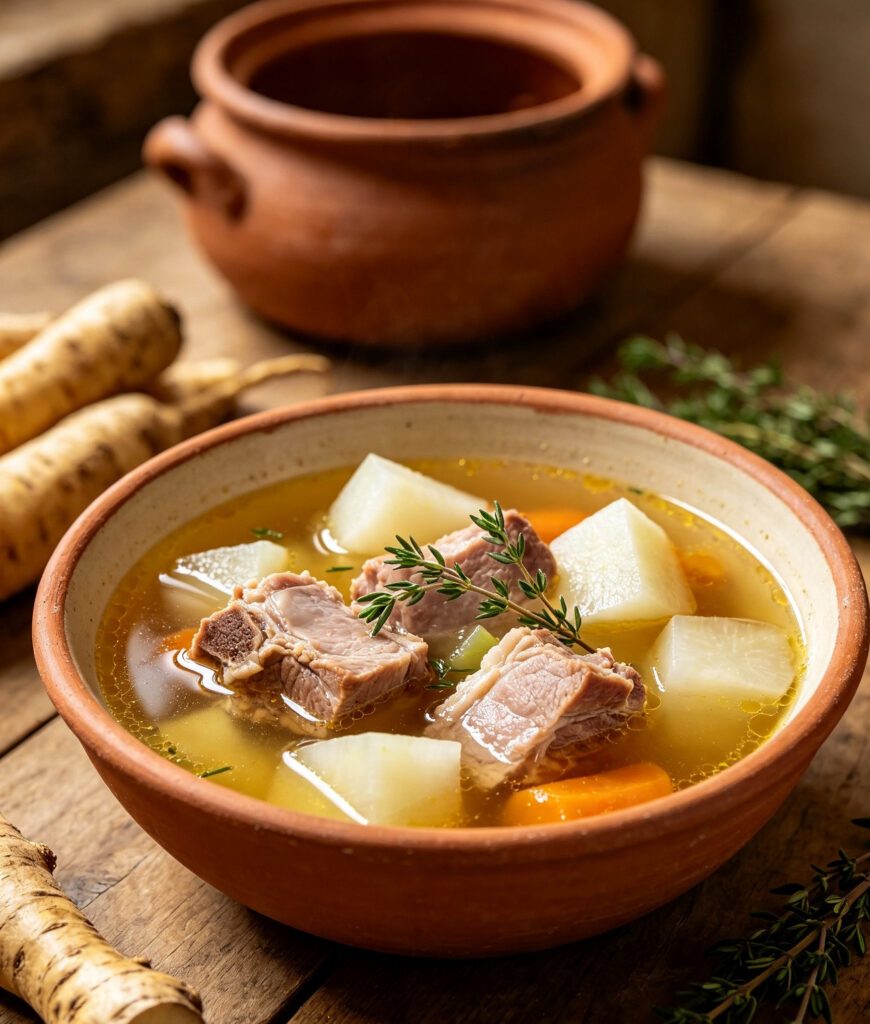
Pork and Turnip Broth
The Quirky Foodster Team
Ingredients
- Pork, cut into chunks — 400 g (0.9 lb)
- Turnips, peeled and chunked — 400 g (0.9 lb)
- Water — 1 L (4 cups)
- Salt — 1 pinch
Method
- Place the pork chunks and water in the pot and bring to a simmer.
- Cook for 30 minutes, skimming any foam from the surface.
- Add the turnip chunks and continue simmering for a further 20-25 minutes, until both the meat and turnips are tender.
- Season with salt and serve hot.
Introduction: A simmered broth of pork and turnip, reflecting pig-keeping’s central place in Gallic farming and feasting as directly described by the Greek observer Posidonius.
Cultural Background: Posidonius, a Greek philosopher who travelled in Gaul in the 2nd century BCE, wrote a detailed ethnography of the Gauls that survives only through later quotation in the works of Athenaeus and Diodorus Siculus; he specifically describes Gauls feasting on large quantities of meat, particularly pork, seated on straw around low tables, making pork-based dishes some of the best-attested foods of continental Celtic society, even though the account comes from an outside Greek observer rather than a Gallic source.
Tips: – Skimming the broth in the early stages of cooking gives a clearer, cleaner-tasting result. – Cut the turnips into even pieces so they cook at the same rate as the meat.
Variations: – Naturally gluten-free and dairy-free as written. – Other root vegetables available in the Gallic countryside can be substituted for turnip.
Storage: Refrigerate covered for up to 3 days.
Reheating: Reheat in a pot over low heat with a splash of water, stirring, for 6-8 minutes until hot throughout.
Nutrition: Per serving (approx.): 240 kcal, 22 g protein, 12 g carbohydrate, 12 g fat, 3 g fibre.
FAQs:
Q: Who was Posidonius and why does his account matter here?
A: Posidonius was a Greek philosopher who travelled in Gaul around the 2nd century BCE and wrote a detailed ethnographic account of Gallic life and customs; although his original text is lost, long sections survive through quotation in the later Greek writers Athenaeus and Diodorus Siculus, making it one of the most important outside sources for continental Celtic diet and feasting practice.
Q: Why was pork so central to Gallic feasting?
A: Posidonius specifically describes Gauls feasting on large quantities of meat, especially pork, as part of communal gatherings, a detail also consistent with the wider archaeological evidence for extensive pig-keeping across Iron Age Gaul.
- Pork, cut into chunks — 400 g (0.9 lb)
- Turnips, peeled and chunked — 400 g (0.9 lb)
- Water — 1 L (4 cups)
- Salt — 1 pinch
Please log in to leave a comment.