
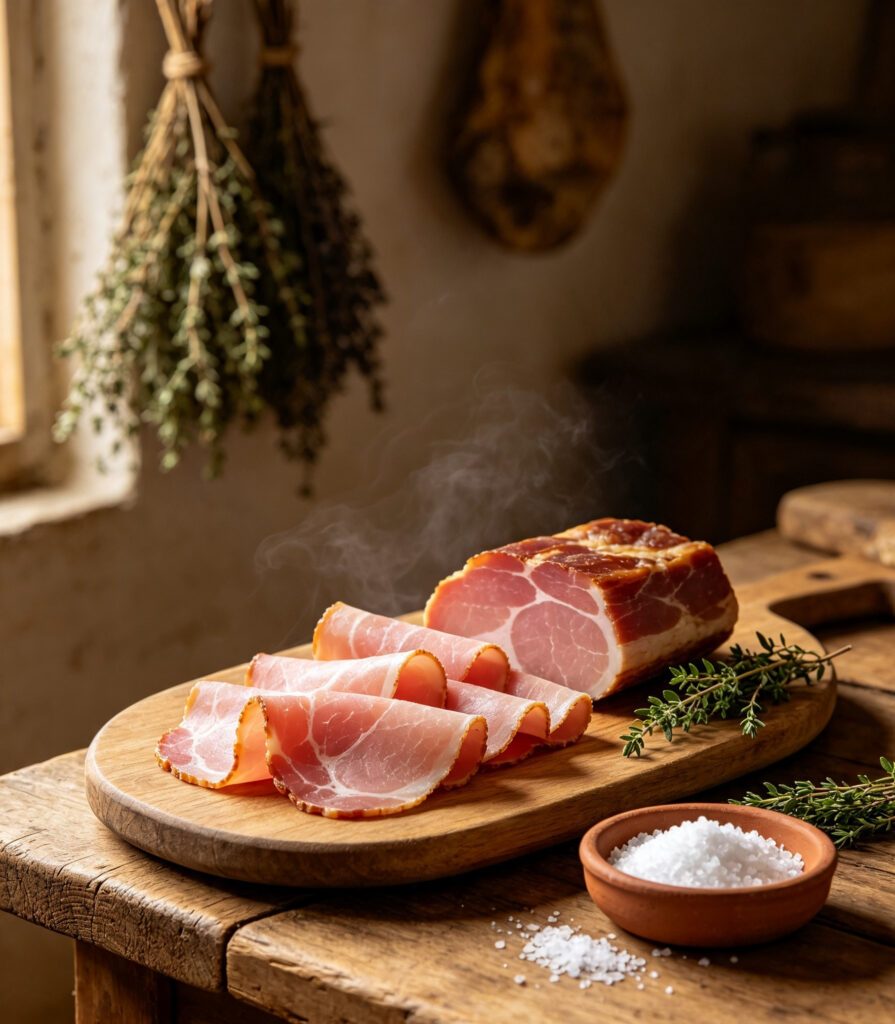
Smoked Ham Slices
The Quirky Foodster Team
Ingredients
- Pork leg joint — 1 kg (2.2 lb)
- Coarse salt — 100 g (0.5 cup)
- Black pepper, optional — 1 pinch
Method
- Rub the pork leg thoroughly all over with the coarse salt.
- Place in a cool container and leave to cure for 5-7 days, turning daily and draining off any released liquid.
- Rinse off the excess salt and pat dry.
- Hang over a low, smoky fire for several hours to a day, until the surface is dried and lightly smoked throughout.
- Slice thinly to serve.
Introduction: Thin slices of smoked, salted ham, a starter drawing directly on Gaul’s genuine ancient reputation for producing exceptional cured pork.
Cultural Background: Gallic hams were sufficiently well regarded in the ancient world to be directly referenced by Roman writers on food and agriculture as a valued export good, reflecting a real and specific culinary reputation distinct from the general archaeological evidence for pig-keeping across Iron Age Europe; the precise curing method used by Gallic producers is not preserved in detail, so this recipe reconstructs a plausible salting-and-smoking process consistent with the technology available at the time.
Tips: – A cool, consistent curing temperature is essential for food safety; work in cool weather or a cool cellar-like space. – Keep the smoking fire low and smoky rather than hot, to dry and flavour the meat without cooking it through too quickly.
Variations: – A shorter cure gives a milder, less intensely salted ham. – This is a naturally gluten-free, dairy-free dish as written.
Storage: Properly cured and smoked ham keeps for several weeks in a cool, dry place, owing to its salt content; refrigerate sliced portions and use within a week once cut.
Reheating: Not applicable; served cold or at room temperature, thinly sliced.
Nutrition: Per serving (approx.): 180 kcal, 24 g protein, 0 g carbohydrate, 9 g fat.
FAQs:
Q: Is the Gallic reputation for good ham really historically attested?
A: Yes, Gallic hams are directly referenced by Roman writers on food and agriculture as a genuinely valued export good, distinct from the more general archaeological evidence for pig-keeping found right across Iron Age Europe.
Q: Is the exact ancient curing method preserved?
A: No, the specific technique used by Gallic producers is not preserved in period sources in technical detail; this recipe reconstructs a plausible salting-and-smoking process using technology available at the time.
- Pork leg joint — 1 kg (2.2 lb)
- Coarse salt — 100 g (0.5 cup)
- Black pepper, optional — 1 pinch
Please log in to leave a comment.