
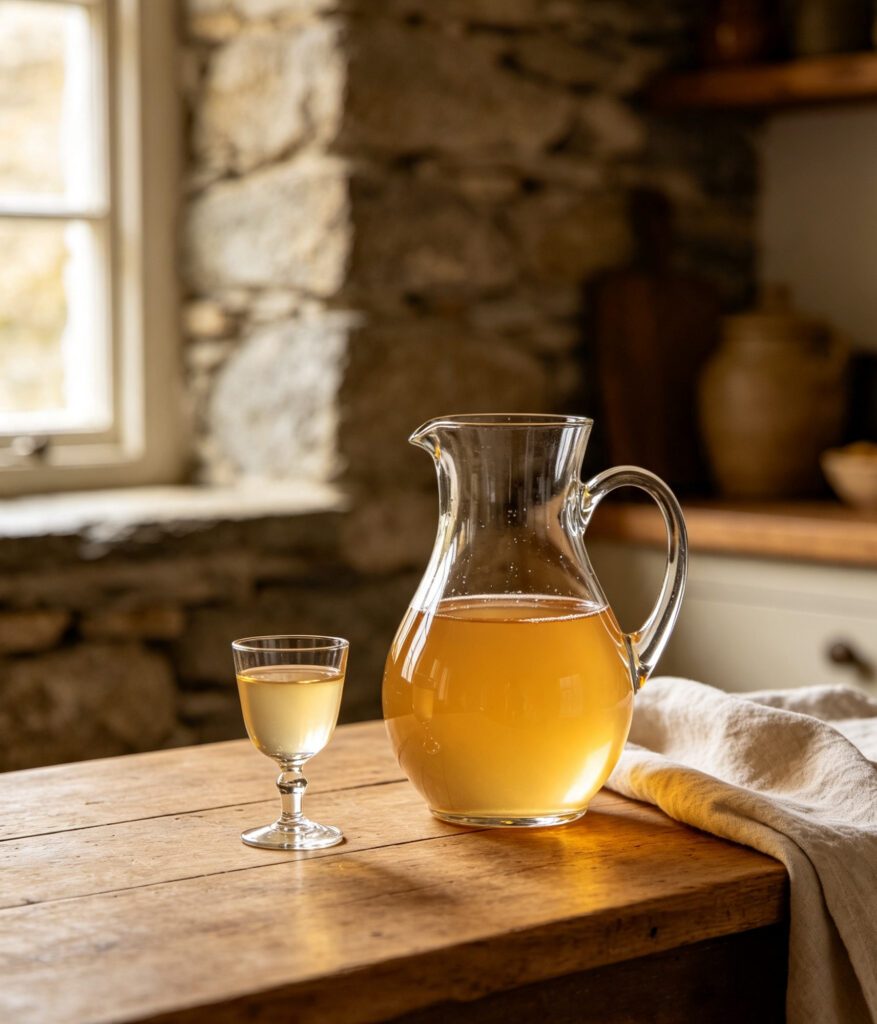
Mead (Honey Wine)
The Quirky Foodster Team
Ingredients
- Honey — 500 g (1.1 lb)
- Water — 2 L (8 cups)
- A small amount of a natural yeast or fermentation starter
Method
- Warm the water gently and dissolve the honey into it fully, stirring well; do not boil, as excessive heat can drive off delicate aromatics.
- Cool the honey-water to room temperature.
- Add the yeast or fermentation starter and stir well.
- Cover the vessel loosely with cloth to allow gases to escape while keeping contaminants out.
- Leave to ferment at room temperature for 1-3 weeks, tasting periodically, until it reaches a pleasantly winey, mildly alcoholic result.
- Strain if needed and serve at room temperature or lightly chilled.
Introduction: A fermented drink made from honey and water, one of the most prestigious beverages of early Irish feasting and hospitality.
Cultural Background: Mead (mid) is directly attested in early Irish literature and place-names (notably Tara’s famous feasting hall, the Teach Miodhchuarta, literally ‘house of the circulation of mead’), reflecting its strongly elite and ceremonial associations in early Irish society, closely tied to the same honey economy documented in the Bechbretha law tract.
Tips: Mead ferments more slowly than grain-based ale and benefits from patience; taste weekly rather than daily. A cooler, more stable room temperature gives a cleaner-tasting result than a warm, fluctuating environment.
Variations: Wild fruit such as blackberries can be added during fermentation for a fruited variant. A shorter fermentation gives a sweeter, less alcoholic result.
Storage: Once fermentation reaches the desired point, refrigerate or bottle and store in a cool place; well-fermented mead keeps considerably longer than ale due to its alcohol and sugar content.
Reheating: Not applicable; this is a cold or room-temperature beverage.
Nutrition: Per serving (approx.): 130 kcal, negligible protein, 22 g carbohydrate, 0 g fat. Contains a variable alcohol content from fermentation.
FAQs:
Q: Why is mead considered especially prestigious in early Ireland?
A: Its strong association with high-status feasting is reflected directly in place-names such as Tara’s feasting hall, the Teach Miodhchuarta (‘house of the circulation of mead’), marking it as a particularly elite beverage.
Q: How long does mead take to ferment?
A: Considerably longer than grain-based ale, typically one to three weeks or more depending on temperature and desired strength, as honey ferments more slowly than malted grain.
- Honey — 500 g (1.1 lb)
- Water — 2 L (8 cups)
- A small amount of a natural yeast or fermentation starter
Please log in to leave a comment.