
Mains
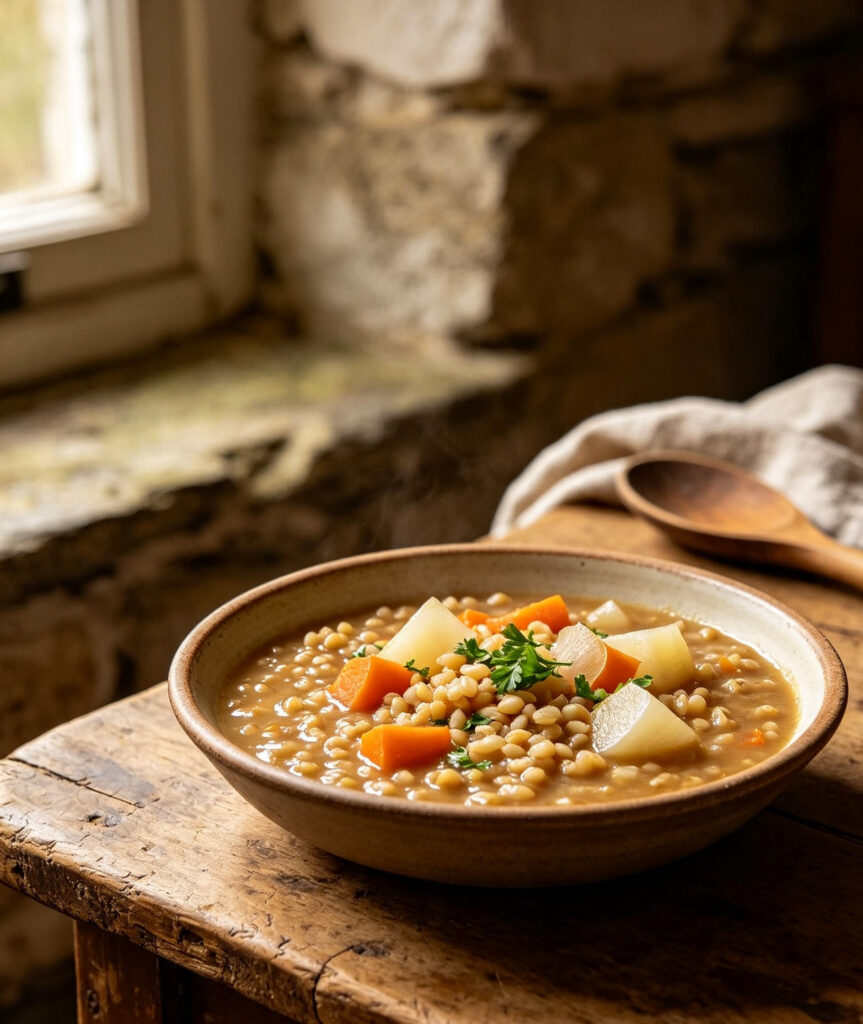
Barley and Vegetable Stew (Nazid Se’orim)
sjfegan
Ingredients
- 170g (1 cup) Barley
- 1 onion, chopped
- 2 carrots, sliced
- 70g (1 cup) Shredded cabbage
- 3 tbsp olive oil
- 5 cups water (1.2 litres / 40 fl oz)
- Salt to taste
Method
- Heat the olive oil in a large pot and sauté the onion until softened.
- Add the barley and water, and bring to a boil.
- Reduce to a simmer and cook for 30 minutes until the barley is nearly tender.
- Add the carrot and cabbage, and simmer for a further 15–20 minutes until all the vegetables are tender.
- Season with salt before serving hot.
Introduction: A hearty stew of barley and seasonal vegetables, a practical and satisfying dish reflecting the everyday cooking of ordinary Carthaginian households.
Cultural Background: While elaborate dishes graced the tables of Carthage’s wealthy merchant class, most households relied on straightforward, grain-based meals like this one, combining the region’s staple barley with whatever vegetables were seasonally available.
Tips: Add the vegetables partway through cooking so they don’t overcook before the barley is tender. Adjust the water quantity for a thicker or looser stew.
Variations: Add any seasonal vegetables on hand, as this dish is highly adaptable. Include a handful of chickpeas for extra protein.
Storage: Refrigerate in an airtight container for up to 4 days.
Reheating: Reheat gently on the stovetop with a splash of water, stirring, until warmed through.
Nutrition: Per serving (approx.): 260 kcal, 7 g protein, 8 g fat, 42 g carbohydrate.
FAQs:
Q: Was barley the staple grain of Carthage?
A: Yes, alongside wheat, barley was extensively cultivated across the fertile North African coastal region controlled by Carthage, forming a fundamental part of the everyday diet.
Q: Were vegetable stews common Carthaginian fare?
A: Simple, grain-based stews using seasonal vegetables would have been practical, everyday meals for most Carthaginian households, similar to other ancient Mediterranean cuisines.
Please log in to leave a comment.