
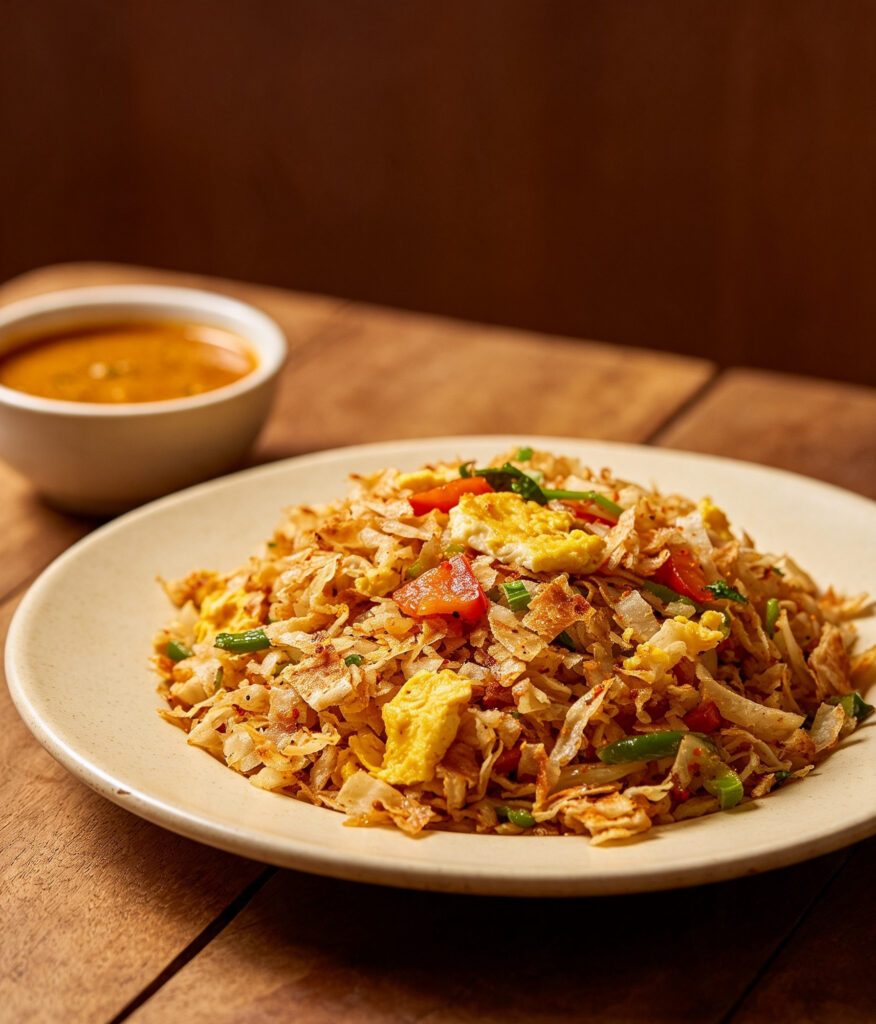
Kottu Roti
The Quirky Foodster Team
Ingredients
- Godamba roti (Sri Lankan flaky flatbread) or paratha, torn into strips — 4
- Chicken, thinly sliced (7 oz) — 200 g (7.1 oz)
- Eggs, lightly beaten — 2
- Onion, sliced (150 g) — 1
- Carrot, julienned (80 g) — 1
- Shredded cabbage (1/2 cup) — 50 g (1.8 oz)
- Green chillies, sliced — 2
- Garlic cloves, chopped — 2
- Curry powder (1 teaspoon) — 3 g
- Chilli powder (1/2 teaspoon) — 2 g
- Curry gravy or leftover curry sauce (3 tablespoons) — 45 ml (3 tbsp)
- Oil (2 tablespoons) — 30 ml (2 tbsp)
- Salt — to taste
Method
- Heat oil on a large flat griddle or wide pan over medium-high heat. Add the onion, garlic and green chillies, and stir-fry for 2 minutes.
- Add the sliced chicken and cook for 4-5 minutes until browned and cooked through.
- Push everything to one side and pour the beaten egg onto the empty space, scrambling it as it cooks, then mix through with the chicken.
- Add the carrot, cabbage, curry powder and chilli powder, and stir-fry for 2 minutes.
- Add the torn roti pieces on top and pour over the curry gravy. Using two spatulas or chopping blades, begin chopping and tossing the mixture together vigorously, mincing the roti into smaller pieces as you mix, for 4-5 minutes, until everything is well combined and heated through.
- Season with salt to taste and serve immediately, hot off the griddle.
Introduction: Kottu roti is Sri Lanka's most famous street food export, instantly recognisable by the rhythmic clanging sound of two metal blades chopping flatbread against a hot griddle – a sound so distinctive that street vendors use it almost like a drumbeat to announce their stalls at night.
Cultural Background: Kottu roti is Sri Lanka's most famous street food export, instantly recognisable by the rhythmic clanging sound of two metal blades chopping flatbread against a hot griddle – a sound so distinctive that street vendors use it almost like a drumbeat to announce their stalls at night. Made from leftover godamba roti (a flaky flatbread) chopped and stir-fried with egg, vegetables, meat and spicy curry sauce, it turns yesterday's bread into a completely new dish, and is one of the few Sri Lankan foods eaten as commonly by teenagers on a night out as by families at home.
Tips: Slightly stale or day-old roti chops better than fresh – it holds its shape rather than turning to mush. The chopping and tossing action is what defines kottu; keep tossing and chopping continuously rather than just stirring, so the roti pieces get evenly minced and coated in sauce. Have all ingredients prepped and ready before you start, as kottu comes together very quickly once cooking begins.
Variations: Cheese kottu adds a generous handful of grated or sliced cheese tossed through at the end for a modern, popular variation. Vegetable kottu omits meat entirely and adds extra vegetables and sometimes tofu for a vegetarian version. Omit the chicken and egg, and use extra vegetables such as mushrooms or tofu, plus a vegetable curry gravy, for a vegetarian or vegan version.
Storage: Refrigerate for up to 1 day in an airtight container, though texture is best fresh.
Reheating: Reheat in a hot pan or wok with a splash of oil, stirring frequently, until heated through; avoid microwaving as the roti turns rubbery.
Nutrition: Approx. 520 kcal, 28 g protein, 22 g fat, 52 g carbohydrates, 4 g fibre per serving
FAQs:
Q: What is godamba roti and can I substitute it?
A: Godamba roti is a thin, flaky Sri Lankan flatbread similar to paratha; frozen paratha (such as Malaysian or Indian brands) is a widely available and effective substitute.
Q: Do I need special blades to make kottu?
A: No, two sturdy metal spatulas used in a chopping motion against the pan work perfectly well at home, even without the traditional twin blades used by street vendors.
Q: Why is kottu associated with a distinctive sound?
A: Street vendors chop the roti with two blades directly against the metal griddle, creating a loud rhythmic clanging that has become culturally iconic and is often used to advertise a stall's location at night.
- Godamba roti (Sri Lankan flaky flatbread) or paratha, torn into strips — 4
- Chicken, thinly sliced (7 oz) — 200 g (7.1 oz)
- Eggs, lightly beaten — 2
- Onion, sliced (150 g) — 1
- Carrot, julienned (80 g) — 1
- Shredded cabbage (1/2 cup) — 50 g (1.8 oz)
- Green chillies, sliced — 2
- Garlic cloves, chopped — 2
- Curry powder (1 teaspoon) — 3 g
- Chilli powder (1/2 teaspoon) — 2 g
- Curry gravy or leftover curry sauce (3 tablespoons) — 45 ml (3 tbsp)
- Oil (2 tablespoons) — 30 ml (2 tbsp)
- Salt — to taste
Please log in to leave a comment.