
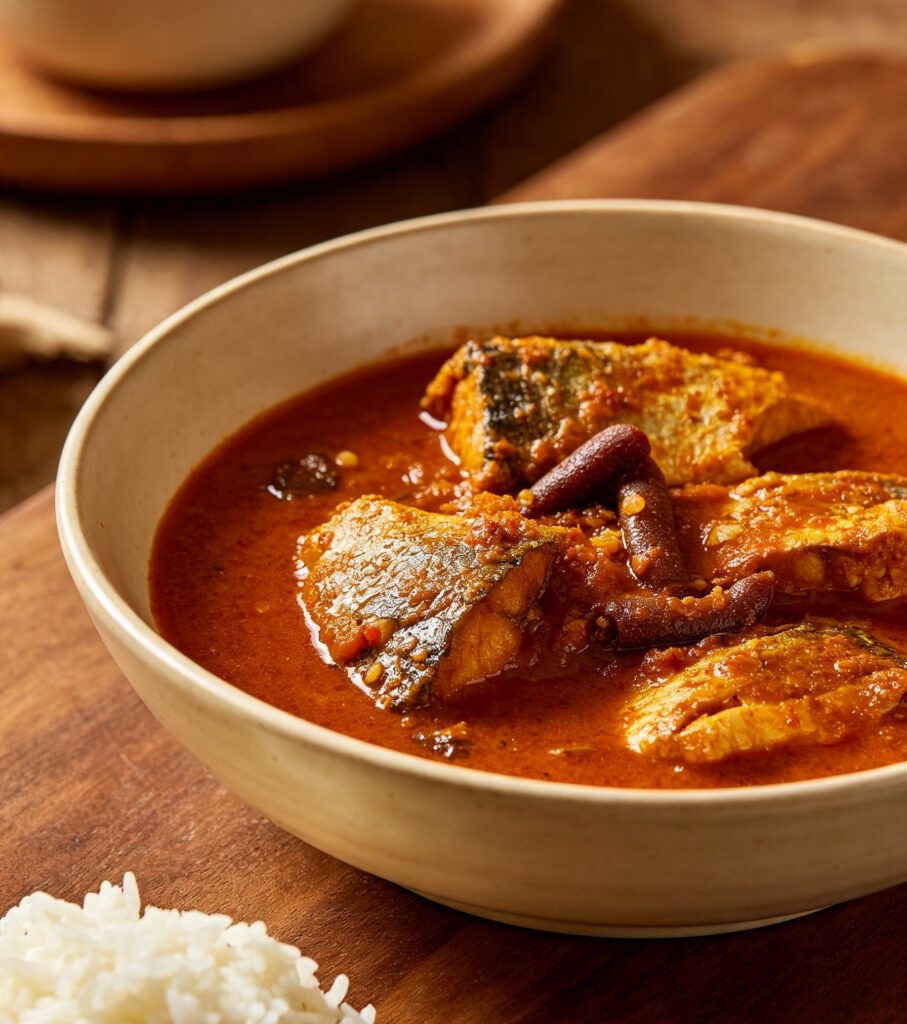
Ambul Thiyal (Sour Fish Curry)
The Quirky Foodster Team
Ingredients
- Firm fish such as tuna, cut into cubes (1.3 lb) — 600 g (1.3 lb)
- Dried goraka (Garcinia cambogia), soaked in warm water — 4 pieces
- Roasted curry powder (1 tablespoon) — 8 g (0.3 oz)
- Chilli powder (1 teaspoon) — 3 g
- Black pepper, ground (1/2 teaspoon) — 1 g
- Turmeric (1/4 teaspoon) — 1 g
- Garlic cloves, crushed — 4
- Ginger, crushed (1 inch) — 2 cm piece
- Curry leaves — 1 sprig
- Pandan leaf (rampe), torn — 1 stick
- Coconut oil (1 tablespoon) — 15 ml (1 tbsp)
- Salt — to taste
Method
- Soak the goraka pieces in 3-4 tablespoons warm water for 10 minutes, then blend or mash to a smooth paste with the soaking water.
- In a bowl, coat the fish cubes with curry powder, chilli powder, pepper, turmeric, crushed garlic and ginger, and the goraka paste, mixing gently so the fish stays intact.
- Transfer the coated fish to a heavy-bottomed pot along with curry leaves, pandan leaf and coconut oil. Add only a few tablespoons of water - just enough to prevent sticking.
- Cook over low heat, covered, for 20 minutes, shaking the pot gently now and then rather than stirring (to keep the fish pieces whole), until the fish is cooked through.
- Uncover and continue cooking over low heat for a further 8-10 minutes, until almost all the liquid has evaporated and the fish is coated in a thick, dark, sticky sauce.
- Season with salt and serve with rice; ambul thiyal is meant to be dry, not saucy.
Introduction: Ambul thiyal is a dry, dark, intensely sour fish curry from Sri Lanka's Southern Province, traditionally made with firm-fleshed fish like tuna and coloured deep brownish-black by goraka (Garcinia cambogia), a dried souring fruit unique to the region.
Cultural Background: Ambul thiyal is a dry, dark, intensely sour fish curry from Sri Lanka's Southern Province, traditionally made with firm-fleshed fish like tuna and coloured deep brownish-black by goraka (Garcinia cambogia), a dried souring fruit unique to the region. Cooked with almost no liquid until the sauce clings tightly to the fish, it was developed as a way to preserve fish without refrigeration – the acidity and dry cooking method extend its shelf life for several days, a practical solution from Sri Lanka's fishing communities that became a beloved dish in its own right.
Tips: Use a firm fish that holds together during the long, gentle cooking – tuna is traditional, but swordfish or firm white fish also work. Shake the pot rather than stirring with a spoon to avoid breaking up the fish pieces. Goraka is the defining ingredient here; if unavailable, tamarind paste can substitute though the flavour and colour will be milder and lighter.
Variations: A version using dried fish (karawala) instead of fresh is made in some coastal households for an even more concentrated, salty result. Some cooks add a few black peppercorns whole for extra warmth alongside the ground pepper. Not converted to vegetarian or vegan, as the dish is defined by its fish preservation technique; there is no traditional plant-based equivalent.
Storage: Because of its low moisture and acidity, ambul thiyal keeps well refrigerated for up to 5 days in an airtight container.
Reheating: Reheat gently in a dry pan over low heat, or in the microwave in short bursts, without adding extra water.
Nutrition: Approx. 260 kcal, 34 g protein, 11 g fat, 4 g carbohydrates, 1 g fibre per serving
FAQs:
Q: What is goraka and can I substitute it?
A: Goraka is a dried souring fruit native to Sri Lanka that gives ambul thiyal its dark colour and sharp sourness; tamarind paste is the closest widely available substitute, though the flavour differs slightly.
Q: Why is this curry so dry compared to other fish curries?
A: It was traditionally cooked this way as a preservation method – less liquid and higher acidity meant the fish kept longer without refrigeration.
Q: What fish works best for ambul thiyal?
A: Firm, meaty fish that hold their shape during slow cooking, such as tuna, are traditional; delicate white fish will break apart too easily.
- Firm fish such as tuna, cut into cubes (1.3 lb) — 600 g (1.3 lb)
- Dried goraka (Garcinia cambogia), soaked in warm water — 4 pieces
- Roasted curry powder (1 tablespoon) — 8 g (0.3 oz)
- Chilli powder (1 teaspoon) — 3 g
- Black pepper, ground (1/2 teaspoon) — 1 g
- Turmeric (1/4 teaspoon) — 1 g
- Garlic cloves, crushed — 4
- Ginger, crushed (1 inch) — 2 cm piece
- Curry leaves — 1 sprig
- Pandan leaf (rampe), torn — 1 stick
- Coconut oil (1 tablespoon) — 15 ml (1 tbsp)
- Salt — to taste
Please log in to leave a comment.