
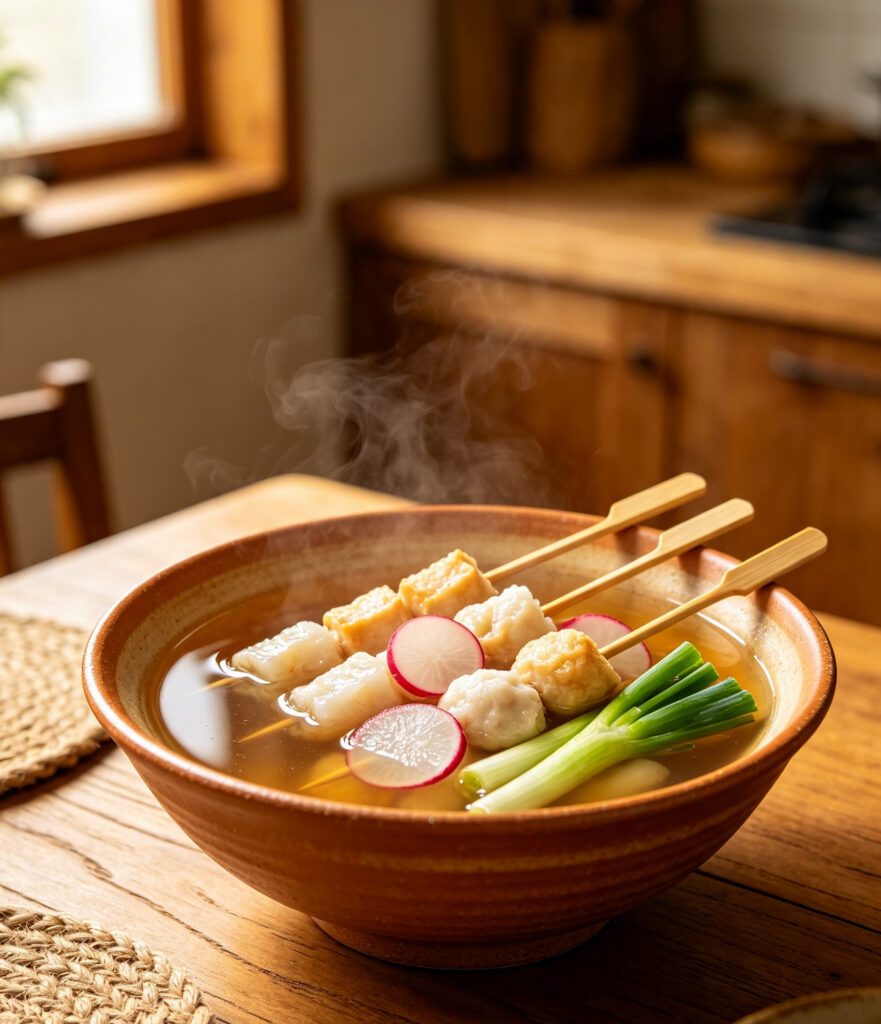
Eomuk Kkochi (Skewered Fish Cake Soup)
The Quirky Foodster Team
Ingredients
- Korean fish cake (eomuk/odeng), folded and threaded onto skewers — 8 sheets
- Anchovy and kelp stock — 1.2 L (5 cups)
- Korean radish, sliced into thick rounds — 1
- Soy sauce — 2 tbsp (30 ml)
- Mirin or rice wine — 1 tbsp (15 ml)
- Garlic cloves, minced — 2
- Spring onions, cut into lengths — 2
- Fresh chilli, sliced, optional — 1
- Salt and pepper, — to taste
- Mustard and extra soy sauce, for dipping
Method
- Fold each sheet of fish cake into a ribbon shape and thread 2–3 folds onto each skewer.
- Bring the anchovy and kelp stock to a boil in a large pot with the sliced radish, and simmer for 10 minutes until the radish begins to soften.
- Add the soy sauce, mirin and garlic, and stir to combine.
- Add the fish cake skewers to the pot, submerging them as much as possible, and simmer for 12–15 minutes until the fish cake is heated through and has absorbed the broth's flavour.
- Add the spring onion and chilli, if using, in the final 2 minutes, and season the broth with salt and pepper to taste.
- Serve the skewers hot in deep bowls with plenty of broth, alongside a small dish of soy sauce and mustard for dipping.
Introduction: Eomuk kkochi — skewered fish cake simmered in a light, savoury broth — is a fixture of Korean street stalls, especially welcome on cold winter evenings when steaming pots of skewers and their hot broth line pojangmacha (street food tent) counters.
Cultural Background: Eomuk kkochi — skewered fish cake simmered in a light, savoury broth — is a fixture of Korean street stalls, especially welcome on cold winter evenings when steaming pots of skewers and their hot broth line pojangmacha (street food tent) counters. Busan, famous for its fish cake production, is particularly associated with high-quality eomuk.
Tips: Fold the fish cake sheets into loose ribbons rather than flat stacks before skewering — this exposes more surface area to the broth and gives the traditional street-stall look. Keep the broth at a gentle simmer rather than a hard boil to avoid toughening the fish cake.
Variations: Add hard-boiled eggs and cubes of tofu to simmer alongside the skewers for a heartier bowl. Finish with a light dusting of gochugaru for a spicier broth. There is no fully authentic vegetarian version, as fish cake is central to the dish; a similar broth can be made with mock fish cake or extra tofu skewers using a kelp and shiitake stock as a non-traditional alternative.
Storage: Refrigerate broth and fish cake separately in airtight containers for up to 2 days.
Reheating: Reheat gently in a pot over medium heat until the broth returns to a simmer and everything is heated through.
Nutrition: Calories: 180 kcal | Protein: 14 g | Carbs: 18 g | Fat: 5 g | Fibre: 2 g | Sodium: 980 mg Per serving; estimate only.
FAQs:
Q: What is Korean fish cake made from?
A: Eomuk is made from ground white fish mixed with starch and seasonings, then steamed or fried into sheets or shapes — it's distinct from Japanese-style oden fish cakes though related in concept.
Q: Can I buy pre-made fish cake sheets?
A: Yes, Korean and Asian grocery stores sell refrigerated or frozen fish cake sheets specifically for skewering and simmering.
Q: Is this the same as Japanese oden?
A: They share a common origin and the Korean name 'odeng' is even borrowed from Japanese, but Korean eomuk kkochi has its own distinct broth style and street-stall presentation.
- Korean fish cake (eomuk/odeng), folded and threaded onto skewers — 8 sheets
- Anchovy and kelp stock — 1.2 L (5 cups)
- Korean radish, sliced into thick rounds — 1
- Soy sauce — 2 tbsp (30 ml)
- Mirin or rice wine — 1 tbsp (15 ml)
- Garlic cloves, minced — 2
- Spring onions, cut into lengths — 2
- Fresh chilli, sliced, optional — 1
- Salt and pepper, — to taste
- Mustard and extra soy sauce, for dipping
Please log in to leave a comment.