
Breakfast
Croissant
The Quirky Foodster Team
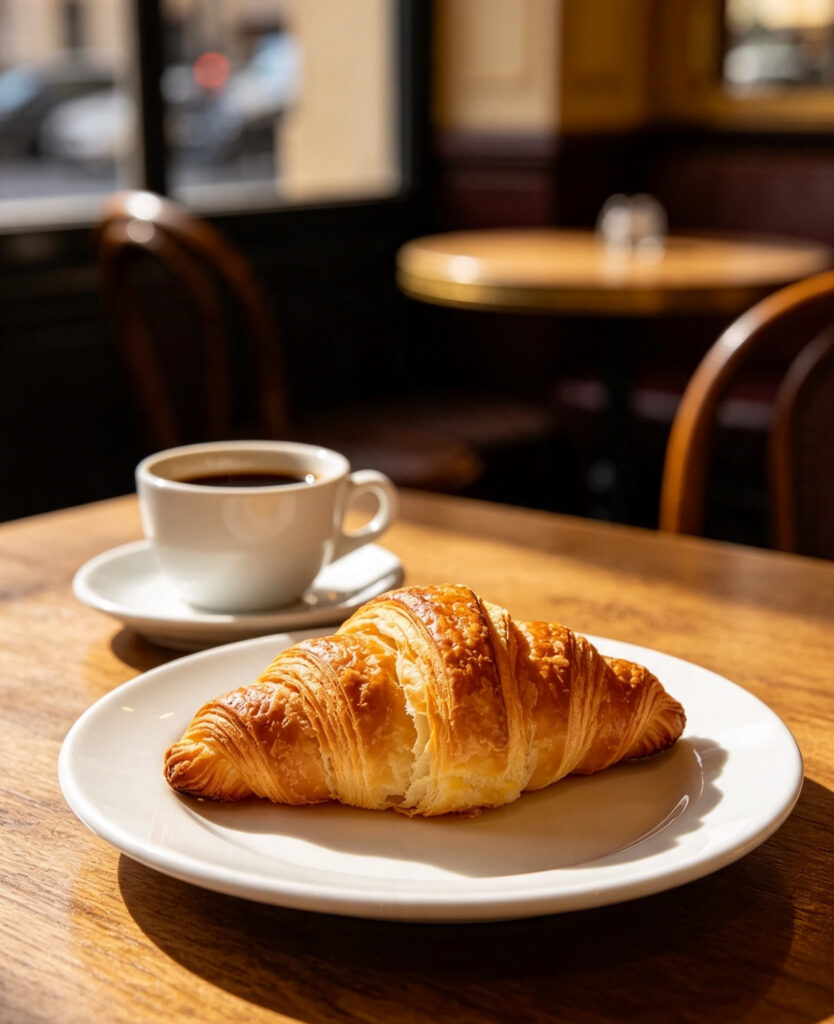
Ingredients
- 500 g (4 cups) Strong white bread flour
- 10 g (2 tsp) Fine sea salt
- 55 g (1/4 cup) Granulated sugar
- 10 g (1 tbsp) Instant yeast
- 300 ml (1 1/4 cups) Cold whole milk
- 40 g (3 tbsp) Melted unsalted butter (for dough)
- 250 g (1 1/8 cups) Cold unsalted butter, 82% fat (for laminating)
- 1 large egg, beaten (for egg wash)
Method
- Mix flour, salt, sugar and yeast in a stand mixer; add cold milk and melted butter, knead 6-8 minutes to a smooth dough.
- Rest dough 1 hour at room temperature, then chill overnight.
- Pound the block of cold butter into a 20x20 cm (8x8 in) square between sheets of parchment.
- Roll dough into a rectangle, encase the butter block, and fold (a single 'book' fold).
- Chill 30 minutes, roll and fold two more times (total 3 folds), chilling between each.
- Roll the laminated dough to 4 mm thickness, cut into triangles, and roll each into a crescent.
- Proof croissants 2-3 hours at warm room temperature until doubled and jiggly.
- Brush with egg wash and bake at 200°C (400°F) for 16-18 minutes until deep golden brown.
Introduction: The croissant descends from the Austrian kipferl and was popularised in France in the 19th century, becoming the definitive symbol of the French breakfast table.
Cultural Background: The croissant descends from the Austrian kipferl and was popularised in France in the 19th century, becoming the definitive symbol of the French breakfast table. Its laminated, buttery layers are the result of a technique perfected in French bakeries (boulangeries) and are now iconic worldwide.
Tips: Keep the butter and dough at the same firmness before laminating; if the butter is harder than the dough it will crack instead of folding evenly.
Variations: Pain au chocolat uses the same dough wrapped around batons of dark chocolate; almond croissants are split, filled with frangipane, and re-baked. Already vegetarian. Substitute plant-based butter and a plant milk with 1 tbsp neutral oil for richness; use an aquafaba wash instead of egg.
Storage: Best eaten the day of baking; store cooled croissants in an airtight container at room temperature for up to 2 days.
Reheating: Refresh in a 160°C (320°F) oven for 4-5 minutes to restore crispness; avoid microwaving, which makes them chewy.
FAQs:
Q: Why didn’t my croissants get flaky layers?
A: The butter likely melted into the dough during rolling; keep everything well chilled and work quickly.
Q: Can I freeze shaped croissants before baking?
A: Yes — freeze after shaping, then thaw and proof fully before baking.
Please log in to leave a comment.